Philippine Offshore Wind Outlook: Deciphering the Multi-Decade Infrastructure Pipeline
With over 63 GW of potential capacity awarded across more than 80 service contracts, the Philippine offshore wind sector represents a massive investment frontier, yet its commercial timeline is strictly bound to port modernization schedules and grid integration pathways.
Key takeaways
- The scale is large. The Department of Energy (DOE) has awarded over 80 Offshore Wind Energy Service Contracts (OWESCs) representing a theoretical pipeline of over 63 GW of clean generation capacity.
- The early leaders are global. Copenhagen Infrastructure Partners (CIP) is developing a 2 GW, USD 5 Billion+ portfolio as the first 100% foreign-owned developer in the country, anchored by the 1 GW San Miguel Bay project in Bicol.1
- The first grid integration pathways are opening. In February 2026, the Triconti-Stream-Seawind consortium secured the country's first-ever grid connection agreements (GAs) for offshore wind, locking in 1.65 GW of capacity across Panay and Negros.2
- Ports are the true gatekeepers. Building massive turbine structures in deep waters requires heavy-lift assembly yards. The DOE and Philippine Ports Authority (PPA) have prioritized three strategic ports (Currimao, Batangas, Jose Panganiban) for repurposing, targeted for 2027 operational readiness.3
- It is a long-horizon play. While solar is a near-term (1–3 years) story, offshore wind is a structural medium-to-long-term (5+ years) play. The real construction and commissioning wave will not hit until the late 2020s and early 2030s.
The structural frontier: wind in deep waters
Offshore wind is the ultimate prize in the Philippines’ renewable energy expansion. Because the country is surrounded by deep coastal trenches with strong, stable marine winds, offshore wind offers a capacity factor and scale that onshore solar or wind can never match.
The policy gravity has shifted heavily behind this resource. Under Executive Order 21, the DOE was directed to establish a fast-track regulatory framework, while the Department of Justice cleared the way for 100% foreign ownership of renewable energy projects, triggering an influx of global capital.
But offshore wind is not solar. You cannot simply bolt a panel to a rack. It is a massive marine construction project requiring deep-water floating foundations, subsea transmission cables, high-capacity ports, and specialized offshore supply vessels (OSVs).
Therefore, separating the speculative "paper contracts" from actual, bankable execution is the key task for institutional investors. The path to commercial operations is gated by two hard constraints: ports and wires.
Strategic Ports: the turbine assembly line
An offshore wind turbine is one of the largest machine structures ever built by humans, with blades exceeding 100 meters and nacelles weighing hundreds of tons. You cannot transport these components by road. They must be manufactured or imported, assembled, and loaded onto heavy installation vessels directly at a high-capacity harbor.
To address this constraint, the DOE and PPA finalized a plan in July 2024 to prioritize and modernize three strategic ports to support the offshore wind supply chain, targeted for 2027 readiness:3
Currimao Port (Ilocos Norte) ──► Supports Northern Luzon floating wind (e.g. 2 GW BuhaWind)
Batangas Port (Sta. Clara)    ──► Supports South Luzon / Verde Island Passage corridors
Jose Panganiban (Cam. Norte)  ──► Supports Bicol / San Miguel Bay (e.g. 1 GW CIP project)
- Currimao Port (Ilocos Norte): Positioned to serve the high-wind floating wind corridor in Northern Luzon.3
- Port of Batangas (Sta. Clara): Positioned near Luzon's major load centers to support southern wind developments.3
- Port of Jose Panganiban (Camarines Norte): Uniquely positioned to support the Bicol region’s massive offshore wind pipeline.3
Our read: Developers are tracking these port upgrades closely. Copenhagen Infrastructure Partners (CIP) has explicitly noted that their construction schedules are directly tied to the PPA's delivery of these modernized, heavy-lift ports. If port development slips past 2027, the entire commercial timeline slips with it.
Wires: the grid integration milestone
Once power is generated at sea, it must be brought to shore via subsea cables and integrated into the national transmission grid.
For years, the industry lacked a formal mechanism for securing grid connection commitments from the National Grid Corporation of the Philippines (NGCP). That changed in February 2026, when the Triconti-Stream-Seawind consortium achieved a landmark industry milestone by securing the first-ever grid connection agreements (GAs) for offshore wind in the Philippines:2
| Project | Location | Capacity | Target Auction |
|---|---|---|---|
| Frontera Bay | Luzon / Manila Bay | 450 MW | GEA-5 |
| Guimaras Strait | Visayas / Negros-Panay | 600 MW | GEA-5 |
| Guimaras Strait II | Visayas / Negros-Panay | 600 MW | GEA-5 |
| Total Portfolio | 1,650 MW |
Implication: Securing these GAs is the critical de-risking event. It provides the consortium with a physical connection pathway to NGCP's Cebu-Negros-Panay (CNP3) backbone (which we analyzed in our Grid Analysis report) and satisfies the strict pre-conditions to bid in the government's upcoming Green Energy Auction 5 (GEA-5). This separates Triconti's portfolio from the pack, establishing it as the most advanced offshore wind play in the country.
Opportunity Scoring: Philippine Offshore Wind
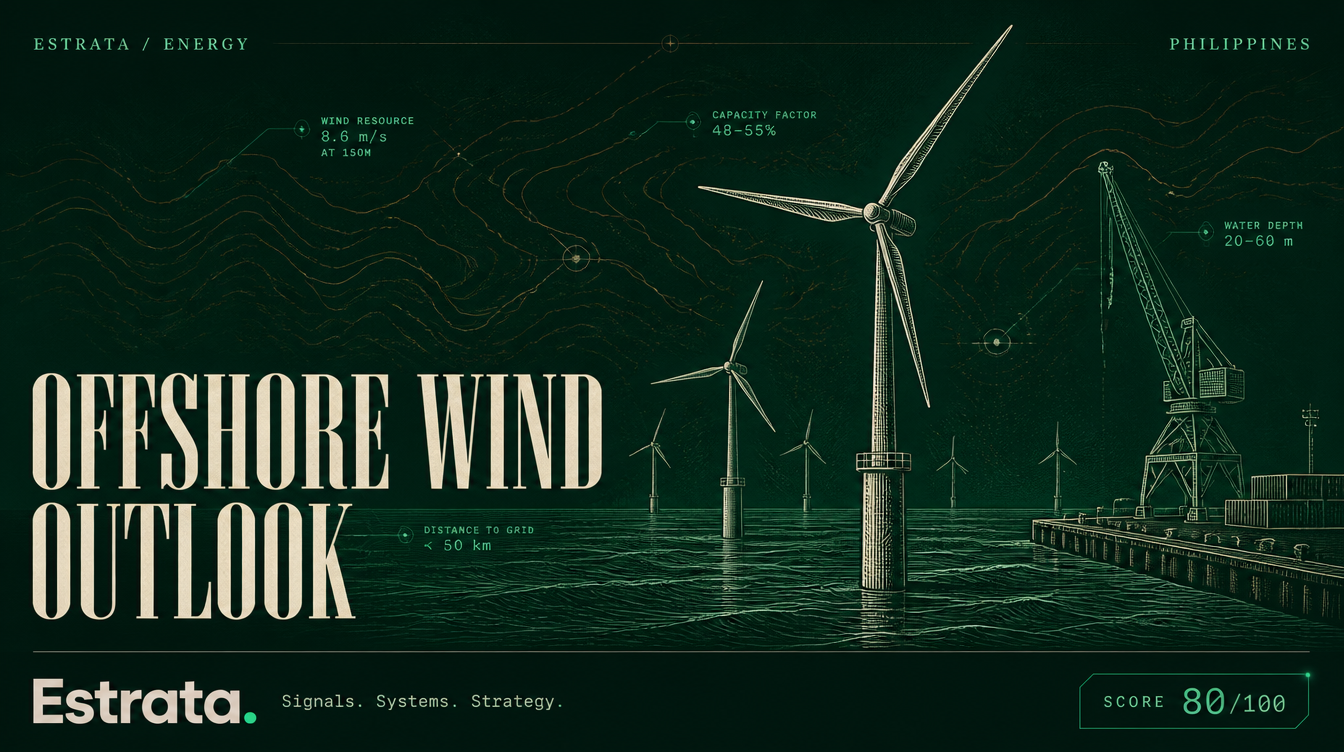
We score the Philippine offshore wind sector at 80/100 under scoring_version: 2026.1 of our reproducible rubric.
[████████████████████████████████░░░░░░░░] 80/100 Medium Confidence
- Capital Scale (98/100): Near maximum score. The offshore wind pipeline represents the largest capital deployment opportunity in Philippine history, with single portfolios (like CIP's 2 GW) carrying a capex exceeding USD 5.0 Billion (₱275B+).
- Government Backing (85/100): Strong support via EO 21, BOI Green Lanes, and fast-track DOJ foreign ownership clearances.
- Readiness (50/100): The primary dampener. The entire sector is in the development and feasibility stage. Ports will not be ready until 2027, and commercial power injection is a post-2028 story.
- Second-Order Effects (90/100): High impact. Opens up massive port industrialization, shipyards, civil maritime engineering, steel fabrication, and subsea cable sectors.
- Evidence Strength (85/100): Sourced from official DOE service contract logs, NGCP grid connection agreements, and corporate filings.
- Competition / Crowding (70/100): High barriers to entry. Because deep-water marine construction requires massive balance sheets and specialized engineering, the space is protected from crowded retail developers, leaving a high-alpha field for major global utilities and specialized consortia.
The complete factor analysis is audited in the backing opportunity record (opp.offshore-wind.philippines.001).
The investment timeline: where the money flows
For institutional investors, the offshore wind timeline dictates where to deploy capital:
- Phase A (2024–2027), Development & Infrastructure: Early-stage capital sits in marine geotech, wind resource measurement, environmental impact assessments (EIA), and civil port engineering (repurposing prioritized ports).
- Phase B (2027–2030), Supply Chain & Grid Integration: Procurement contracts for turbines, subsea transmission cables, substation hardware, and specialized marine logistics (tugs, installation vessels).
- Phase C (2030+), Commercial Operations: Long-term cash-flow yields from power purchase agreements (PPAs) secured under the Green Energy Auction Program (GEA-5).
What to watch next
- GEA-5 offshore wind rules. The terms of reference and target tariffs for Green Energy Auction 5 will dictate the pricing and bankability of these early-mover projects.
- Currimao and Jose Panganiban port construction logs. Direct tracking of the PPA's civil engineering works at these sites is the best leading indicator for offshore wind construction timelines.
- CIP's San Miguel Bay partnership execution. How CIP and ACEN execute the 1 GW San Miguel Bay project will establish the operational template for foreign-domestic developer partnerships.
Sources
- DOE, DOE signs landmark offshore wind contracts with Copenhagen Infrastructure Partners (30 Mar 2023): CIP 2 GW OWESCs, San Miguel Bay, Northern Samar, Pangasinan capacities. https://legacy.doe.gov.ph/press-releases/doe-signs-landmark-offshore-wind-contracts-first-fully-foreign-owned
- BusinessWorld, Triconti wins grid nod for P303-B wind projects (24 Feb 2026): Seawind/Stream/Triconti consortium, 1.65 GW portfolio via NGCP grid-connection agreements, Frontera Bay (450 MW) + Guimaras Strait I & II (600 MW each), GEA-5 eligibility. https://www.bworldonline.com/corporate/2026/02/24/732267/triconti-wins-grid-nod-for-p303-b-wind-projects/
- DOE, DOE and PPA collaborate to repurpose strategic ports for offshore wind integration (15 Jul 2024): Currimao, Batangas, Jose Panganiban ports prioritized, PPA development plan. https://legacy.doe.gov.ph/press-releases/doe-and-ppa-collaborate-repurpose-strategic-ports-offshore-wind
- Copenhagen Infrastructure Partners (CIP) corporate updates, San Miguel Bay 1 GW offshore wind development (Oct 2025): Port logistics timelines and ACEN partnership. https://cleantechnica.com/2025/10/01/largest-solar-energy-projects-in-the-philippines-online-and-in-the-pipeline/
Backing structured records (provenance trail): signals sig.energy.2023-03-31.0001, sig.energy.2026-02-24.0001, sig.infrastructure.2024-07-15.0001; opportunity opp.offshore-wind.philippines.001 (score 80, scoring_version: 2026.1).
Estrata provides research and analysis for informational purposes only. It is not financial, investment, legal, or tax advice and is not a recommendation to buy or sell any security or asset. Figures are drawn from public sources and may contain errors; verify independently before making decisions.