Philippine Grid Analysis: The Infrastructure Backbones Deciding the Energy Future
With over 9.3 GW of new variable solar and wind contracted through the Green Energy Auction pipeline, the critical bottleneck shifts from generation to the grid, making transmission expansion, interconnection, and battery storage the primary gateways for investment returns.
Key takeaways
- The wire is the ultimate gatekeeper. Building generation capacity is bankable, but evacuating that power is not guaranteed. Transmission capacity (not the solar or wind resource) increasingly determines where capital can successfully land.
- Luzon's bottleneck has been opened. The full completion of the Mariveles-Hermosa-San Jose 500kV Transmission Line in June 2024 freed up 8,000 MW of transfer capacity, releasing severe transmission congestion in Bataan and Zambales and opening the path for Central Luzon megaprojects.1
- The Visayas is building a double-circuit backbone. The energization of the Cebu-Negros-Panay (CNP) 230kV Backbone Stage 3 in March 2024 doubled inter-island transfer capacity to 380 MW, providing Negros' massive solar projects a pathway to Cebu's high-demand load centers.2
- The national grid is unified for the first time. The commercialization of the Mindanao-Visayas Interconnection Project (MVIP) links Luzon, Visayas, and Mindanao into a single, synchronized power market, enabling inter-island power sharing and stabilizing variable renewables.
- Ancillary services represent the new alpha. The rush of variable solar under the DOE's Green Energy Auction 4 (GEA-4) makes grid-tied battery energy storage systems (BESS) a structural necessity for grid stability, transforming storage from a premium add-on to a mandatory pre-condition.3
Why the grid is the story
For decades, energy investment in the Philippines was dominated by a single objective: adding raw generation capacity to meet chronic reserve deficits, but as the transition to renewable energy accelerates, a new structural reality has emerged.
In a power system distributed across an archipelago, the binding constraint is no longer generation. It is transmission.
The Department of Energy's (DOE) aggressive targets (including the massive 9,378 MW Green Energy Auction 4 (GEA-4)) will flood the system with intermittent solar and wind power.3 These resources are geographically concentrated: solar in the flat, sun-drenched plains of Central Luzon; wind along the rugged coastlines of Northern Luzon and Western Visayas.
But these generation hubs are often hundreds of kilometers away from the major urban and industrial load centers (Metro Manila, Cebu, and Davao). Without adequate high-voltage transmission lines to evacuate this electricity, variable renewable plants face severe curtailment: forced shutdowns by the grid operator to prevent grid overload.
For developers, a curtailed megawatt-hour is zero revenue. Therefore, understanding where transmission capacity is expanding is the single most important task for underwriting energy capital.
The backbones: two case studies in capacity
Between 2024 and 2026, the National Grid Corporation of the Philippines (NGCP) completed several highly delayed, critical backbone projects that radically altered the power evacuation landscape.
1. The Luzon 500kV Backbone: Mariveles-Hermosa-San Jose
Historically, Bataan and Zambales provinces represented a severe transmission bottleneck. A massive concentration of baseload thermal plants (such as GNPower Dinginin) and emerging utility-scale solar projects were forced to squeeze through outdated, low-capacity lines, causing chronic congestion.
On June 23, 2024, NGCP fully energized the Mariveles-Hermosa-San Jose 500kV Transmission Line at its maximum 8,000 MW transfer capacity.1
| Project Detail | Operational Fact |
|---|---|
| Full Energization | June 23, 2024 (Inaugurated July 12, 2024)1 |
| Physical Scope | 395 transmission towers, 275.6 circuit-km of lines, two new 500kV substations1 |
| Total Transfer Capacity | 8,000 MW (expanded from initial 2,000 MW in 2023)1 |
| Total Capex | PHP 20.9 Billion1 |
Our read: Opening 8,000 MW of headroom does more than just evacuate Bataan's current generation. It serves as the structural pre-condition for the massive 3,500 MWp MTerra Solar + 4,500 MWh storage megaproject in Nueva Ecija and Bulacan, whose first 600 MW block successfully energized and synchronized with the Luzon grid in February 2026.4 Without the 500kV backbone, a project of MTerra's scale would have been physically impossible to connect.
2. The Visayas 230kV Backbone: Cebu-Negros-Panay (CNP3)
The Visayas grid has long been characterized by a geographic mismatch: Negros island produces vast amounts of cheap solar power, Panay is historically power-deficit, and Cebu is the primary industrial consumer.
Because the subsea cables linking Negros to Cebu were highly constrained, solar energy in Negros was regularly curtailed during peak solar hours, while Cebu was forced to run expensive diesel-fired peaking plants.
On March 27, 2024, NGCP completed and energized the Cebu-Negros-Panay (CNP) 230kV Backbone Project Stage 3.2
Panay (Deficit) ◄──[CNP3 Subsea/Overhead]──► Negros (Solar Surplus) ◄──[CNP3 Subsea/Overhead]──► Cebu (Industrial Load)
- Transfer Capacity: Boosted inter-island transfer capacity to 380 MW.2
- Infrastructure: 544 towers, 354 circuit-km of overhead lines, 58 circuit-km of subsea cables, and 10 substations.2
- Investment Capex: PHP 67.9 Billion.2
Implication: The completion of CNP3 immediately stabilized the Visayas grid and laid the groundwork for utility-scale solar expansion. It is the direct enabler of Aboitiz Renewables' 173 MWp Calatrava plant in Negros Occidental, which achieved full commercial operations in July 2025 as the largest variable renewable asset on the Visayas grid.5
Opportunity Scoring: Philippine Grid Modernization
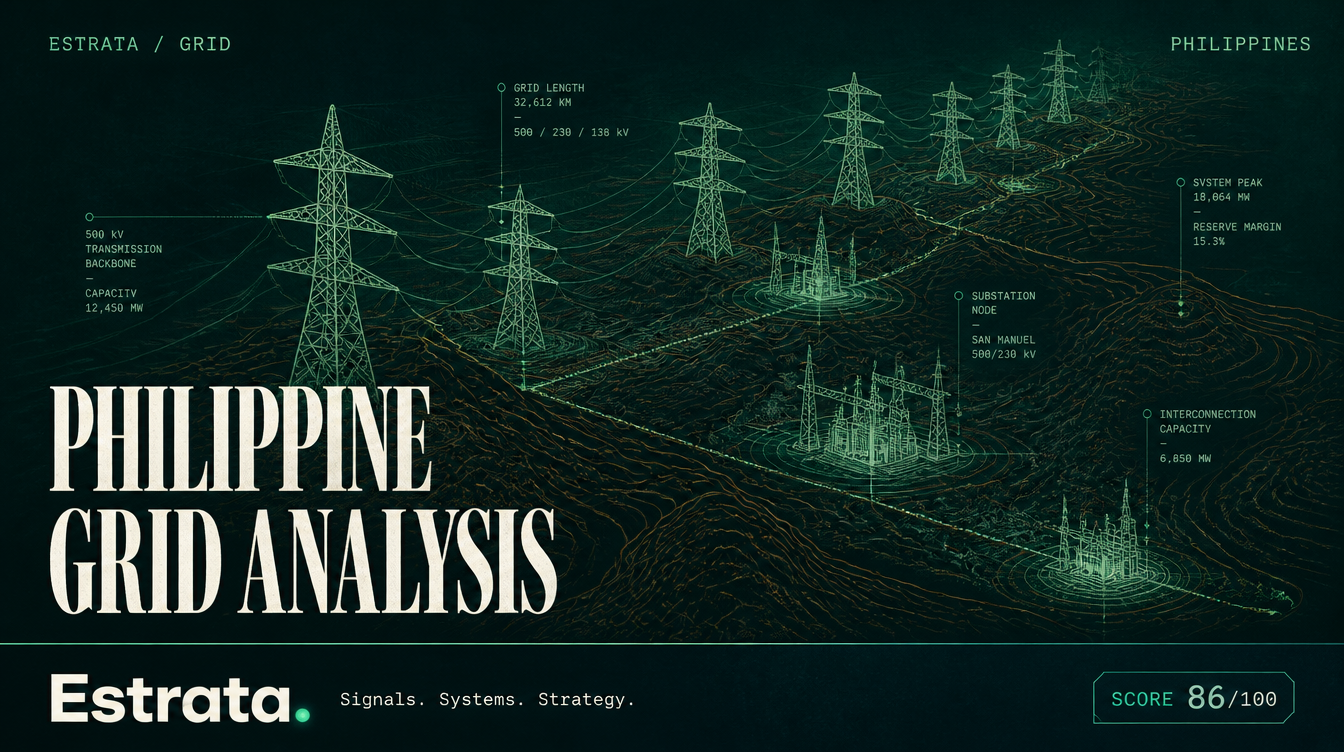
We score the cross-island grid expansion opportunity at 86/100 under scoring_version: 2026.1 of our reproducible investment rubric.
[██████████████████████████████████████░░░░] 86/100 High Confidence
- Capital Scale (95/100): Transmission backbone upgrades represent multi-billion PHP undertakings (CNP3 alone was PHP 67.9B). The long-term grid expansion plan through 2030 exceeds PHP 100B in planned capital deployment.
- Government Backing (90/100): These backbone projects carry the highest level of regulatory backing: ERC mandated, NEDA monitored, and fast-tracked via DOE Certificates of Energy Projects of National Significance (CEPNS).
- Readiness (85/100): The primary trunk lines (MVIP, CNP3, Hermosa-San Jose) are operational and energized. The ongoing risk sits at the local substation and distribution connection levels.
- Second-Order Effects (95/100): Maximum score. Every single energy project (GEA-4's 9.3 GW), provincial data center, and economic manufacturing zone is structurally dependent on these lines.
- Evidence Strength (90/100): Supported by high-integrity, primary Tier A sources (NGCP energization records, ERC project audits, Presidential executive statements).
- Competition / Crowding (45/100): NGCP holds a private monopoly concession over the transmission system. However, the supplier and contractor market is highly open, creating massive private opportunities in EPC contracting, equipment supply (transformers, switchgears, subsea cables), and auxiliary services.
The full factor analysis is audited in the backing opportunity record (opp.grid-backbone.visayas-luzon.001).
The investment frontier: where capital sits
For investors, grid modernization creates three major opportunities:
- EPC and Equipment Supply: Transmission tower construction, high-voltage subsea cables, and substation hardware. As NGCP continues its capital expenditure rollout to connect new solar zones, procurement streams are steady and highly visible.
- Ancillary Services & Battery Storage (BESS): Variable solar requires rapid-response grid stabilization. Developers pairing solar with battery storage (such as the 1,100 MW BESS allocation in GEA-4 or MTerra's massive 4,500 MWh battery) will capture high-margin ancillary service agreements from NGCP to regulate grid frequency.34
- Data Center Co-location: Hyperscale operators require high-density, green power. Unclogged transmission corridors in Central Luzon (Nueva Ecija/Bataan) allow data centers to locate near high-capacity renewable installations while maintaining secure, grid-tied redundancy.
What to watch next
- NGCP's next regulatory rate reset. The ERC's final decision on NGCP's allowed revenues and tariffs will directly impact the capital available for its transmission expansion plans.
- GEA-4 tariff awards. The bidding results for the 1,100 MW solar-plus-storage tranches will reveal the market clearing price for grid-stabilizing storage.
- Interconnection lead times. Watch for delays in local substation upgrades. While the major 500kV and 230kV trunks are open, the "last mile" connection to specific projects remains a common delay bottleneck.
Sources
- NGCP, NGCP fully energizes Cebu-Negros-Panay Backbone Project (8 Apr 2024): CNP3 physical scope, towers, subsea cables, and energization. https://www.ngcp.ph/post/ngcp-fully-energizes-cebu-negros-panay-backbone-project [cached: https://webcache.googleusercontent.com/search?q=cache:www.ngcp.ph/post/ngcp-fully-energizes-cebu-negros-panay-backbone-project]
- NGCP, NGCP fully energizes Hermosa-San Jose 500kV Backbone (23 Jun 2024): HSJ scope, capacity, towers, substations, and capex. https://www.ngcp.ph/post/ngcp-fully-energizes-hermosa-san-jose-500kv-backbone [cached: https://webcache.googleusercontent.com/search?q=cache:www.ngcp.ph/post/ngcp-fully-energizes-hermosa-san-jose-500kv-backbone]
- DOE, Philippines opens Green Energy Auction 4 (12 Mar 2025): GEA-4 solar, wind, and BESS capacity tranches. https://legacy.doe.gov.ph/press-releases/philippines-opens-green-energy-auction-4-integrating-energy-storage-sustainable
- Meralco PowerGen, MTerra Solar Project Breaks Ground (22 Nov 2024): MTerra 3.5 GWp solar + 4.5 GWh battery storage details. https://www.meralcopowergen.com.ph/mterra-solar-project-breaks-ground-a-monumental-milestone-in-the-philippines-renewable-energy-transition/
- CleanTechnica, Largest Solar Energy Projects in the Philippines (1 Oct 2025): Calatrava 173 MWp operational status in Negros. https://cleantechnica.com/2025/10/01/largest-solar-energy-projects-in-the-philippines-online-and-in-the-pipeline/
Backing structured records (provenance trail): signals sig.grid.2024-04-08.0001, sig.grid.2024-06-23.0001; opportunity opp.grid-backbone.visayas-luzon.001 (score 86, scoring_version: 2026.1).
Estrata provides research and analysis for informational purposes only. It is not financial, investment, legal, or tax advice and is not a recommendation to buy or sell any security or asset. Figures are drawn from public sources and may contain errors; verify independently before making decisions.
Footnotes
-
NGCP Mariveles-Hermosa-San Jose Press Release, 23 Jun 2024 (
src.ngcp.press.2024-06-23.0001). ↩ ↩2 ↩3 ↩4 ↩5 ↩6 -
NGCP Cebu-Negros-Panay Press Release, 8 Apr 2024 (
src.ngcp.press.2024-04-08.0001). ↩ ↩2 ↩3 ↩4 ↩5 -
DOE GEA-4 press release, 12 Mar 2025 (
src.doe.press.2025-03-12.0001). ↩ ↩2 ↩3 -
Meralco PowerGen press release, 22 Nov 2024 (
src.meralcopowergen.press.2024-11-22.0001). ↩ ↩2 -
CleanTechnica, 1 Oct 2025 (
src.cleantechnica.web.2025-10-01.0001). ↩