The Philippines' Telecom Rivals Just Called a Truce on Undersea Cables
PLDT, Smart, and DITO agreed on July 3 to stop duplicating towers, indoor coverage systems, and international cable capacity, just as two new subsea cable systems land in the same two provinces and roughly triple the country's cross-border bandwidth by 2028. The competitive edge in Philippine telecom is moving from owning cables to owning the fiber and power that connect them to data centers.
Key takeaways
- On July 3, 2026, PLDT, its wireless arm Smart, and rival DITO Telecommunity signed a non-monetary memorandum of understanding to reciprocally share cell towers, in-building coverage systems, and international submarine cable capacity instead of building duplicate infrastructure.12
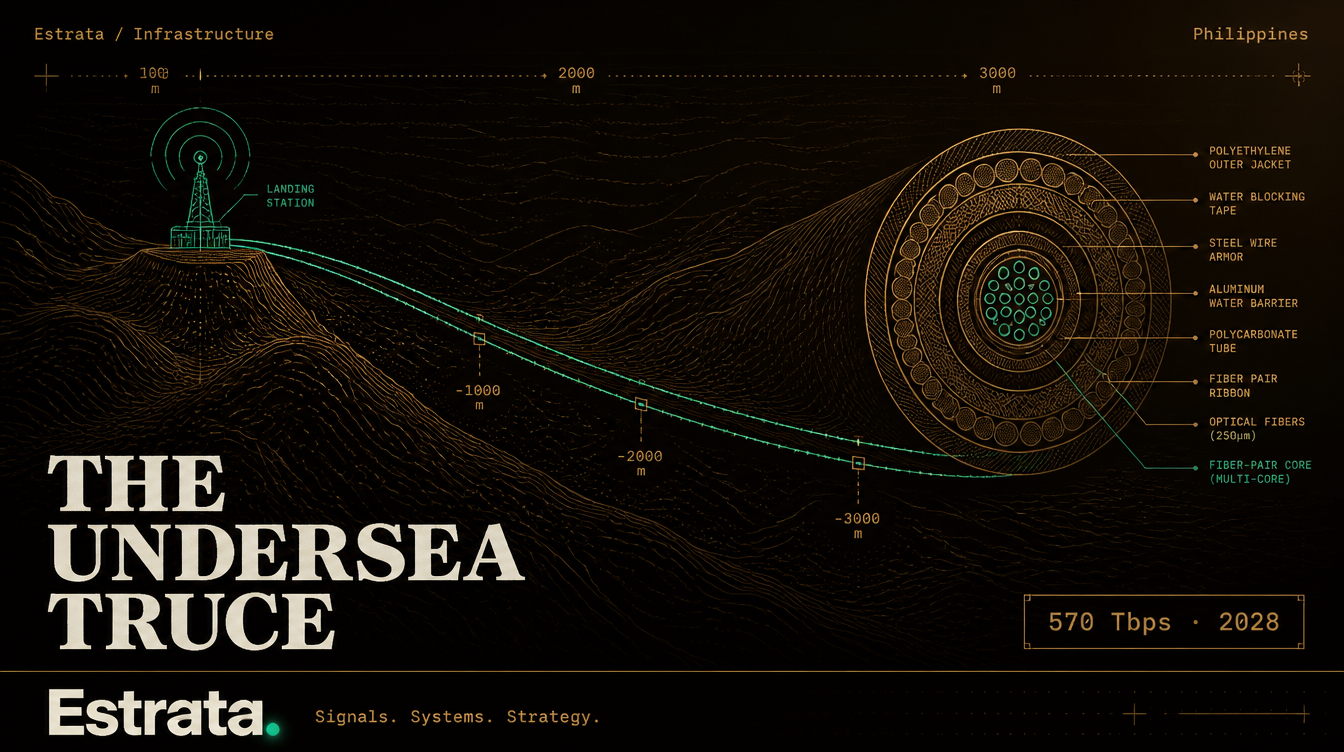
- The truce lands as two new subsea cable systems physically converge on the same two provinces: PLDT's Apricot (12,000 km, over 190 Tbps design capacity) already landed at Baler, Aurora and Digos, Davao, and Globe's Candle (8,000 km, up to 570 Tbps) is set to land at Nasugbu, Batangas and also at Baler, Aurora, targeting service by 2028.34
- Globe is directing roughly USD 1 billion (about PHP 56 billion) of 2026 capital spending mostly toward fiber and data infrastructure, anticipating AI-driven data traffic to rise as much as tenfold, while its STT GDC Philippines joint venture with Ayala brought the 124 MW Fairview data center online.56
- Our read: international bandwidth itself is being commoditized, through multi-carrier consortium cables and now a rival sharing pact. The investable, differentiable assets are migrating downstream, to landing-station land, the terrestrial fiber that backhauls capacity into data center clusters, and the power supply behind them, not to the cables.
The truce is the signal, not the cables
Telecom rivals do not usually agree to hand each other keys to their own networks. On July 3, PLDT and Smart Chairman Manuel Pangilinan and DITO CEO Eric Alberto signed exactly that kind of deal: reciprocal, no-cash rights to use each other's cell tower sites, indoor coverage systems in malls, offices, and hospitals, and international submarine cable capacity.1 The arrangement runs on an indefeasible-right-of-use basis rather than a lease, meaning no money changes hands.2
Pangilinan framed it as coexistence, not surrender: "This agreement reflects that, even as we compete in the marketplace, we can collaborate where it matters the most."2 Markets read it as good news for both incumbents: PLDT shares rose 3.54 percent and DITO CME gained 2.78 percent the day the deal was reported.2
The strategic logic is straightforward. Building a second tower next to a competitor's, or laying a second cable on a route another carrier already serves, is capital that earns a below-market return once two networks already cover the same ground. Sharing towers and indoor systems converts that duplicated capex into avoided capex for all three parties. Sharing submarine cable capacity does something more specific: it tells investors that owning an undersea cable is no longer, by itself, a competitive moat in the Philippine market. It is quickly becoming shared infrastructure, priced in avoided capex rather than exclusivity.
Two new cables, one province, twice
The MOU did not happen in a vacuum. It follows the completed landing of PLDT's Apricot cable, a 12,000-kilometer, multi-fiber-pair system built with Chunghwa Telecom, NTT, Google, and Meta, with a design capacity above 190 Tbps.3 Apricot lands at two Philippine stations: Baler in Aurora province and Digos in Davao del Sur, and is expected to lift PLDT's own international capacity by about a third, to more than 140 Tbps.7
Globe is close behind with Candle, an 8,000-kilometer, 24-fiber-pair cable built with Meta, SoftBank, Telekom Malaysia, and Indonesia's XLSmart (NEC is the system supplier), rated at up to 570 Tbps of total capacity and targeting service by 2028. Candle connects the Philippines to Taiwan, Japan, Malaysia, Indonesia, and Singapore, with landing stations at Nasugbu in Batangas (built and financed by Globe) and, notably, a second station in Baler, Aurora, operated by IPS Inc.'s local unit InfiniVAN.4
| Cable | Length | Capacity | PH landing stations | Consortium | Target |
|---|---|---|---|---|---|
| Apricot (PLDT) | 12,000 km | >190 Tbps | Baler, Aurora; Digos, Davao del Sur | PLDT, Chunghwa Telecom, NTT, Google, Meta | Live |
| Candle (Globe) | 8,000 km | up to 570 Tbps | Nasugbu, Batangas; Baler, Aurora | Globe, Meta, SoftBank, Telekom Malaysia, XLSmart | 2028 |
Our read: Aurora province, a coastal frontier with almost no prior presence in Philippine investment coverage, is now the landing point for two unrelated hyperscaler-backed cable systems. That is not a coincidence of geography so much as a scarcity signal: a handful of coastal sites with the seabed access, permitting runway, and NTC-cleared right of way for a cable landing station are being claimed early, by whichever carrier moves first. Once claimed, that land and the earth station built on it become durable infrastructure regardless of which cable segment eventually carries the traffic, exactly the kind of asset the new sharing MOU makes more, not less, valuable, since capacity on it can now be resold or reciprocally shared rather than sitting idle.
Where the value actually migrates
The reason three capital-intensive projects, a sharing pact, and two new cables are converging in the same 12 months is sitting inland: data centers. Globe's 2026 capital budget, roughly USD 1 billion, or about PHP 56 billion, is aimed substantially at fiber densification and data infrastructure, on the expectation that AI workloads could push data traffic up by a factor of ten.5 Globe's STT GDC Philippines venture with Ayala brought its flagship Fairview facility online in 2025 and 2026, a 124 MW facility that Globe, Radius Telecoms, and Source Telecoms all connect into.6 STT GDC's parent was itself absorbed into a roughly USD 5.1 billion KKR-Singtel buyout in 2026, which the local venture's leadership said would give it "enhanced scaling power" to expand faster in the Philippines.8
Read together with Estrata's existing data center pipeline coverage, the subsea layer is the missing upstream piece of that story. A data center is only as useful as the international bandwidth reaching it, and that bandwidth is now arriving through cables that are explicitly multi-carrier and, as of July 3, explicitly shareable across the three biggest network operators in the country. That reduces the odds that any single telco captures outsized returns from owning a cable outright. It raises the odds that value concentrates in three narrower places: the physical landing-station real estate in Aurora and Batangas, the terrestrial backhaul fiber connecting those stations to Luzon's data center clusters in Clark, Cavite, and Fairview, and the power generation and grid capacity those data centers need, a constraint Estrata has already flagged as the binding one for the sector.
What to watch
- Landing-station buildout progress at Baler, Aurora, the one site hosting both major new cable systems, is a concentration risk and a leading indicator worth tracking on its own.
- Whether the PLDT-Smart-DITO cable-sharing terms extend to Globe, which was not a signatory to the July 3 MOU; a fourth-carrier addition would confirm this is becoming an industry norm rather than a one-off deal.
- Candle's 2028 in-service date, the single hardest catalyst in this story, given submarine cable projects routinely slip on marine survey and permitting timelines.
- STT GDC Philippines locator announcements following the KKR-Singtel ownership change, as a signal of whether the new parent accelerates or pauses Philippine expansion.
Risks
The sharing pact is voluntary and non-binding in the sense that any party could decline to renew or expand it once conditions change; it is not a regulatory mandate. Both new cable systems depend on continued demand from the same handful of foreign hyperscalers (Google, Meta, SoftBank, NTT) that anchor their consortiums, so a pullback in US or Japanese cloud capital expenditure would delay Philippine landing-station investment more than any domestic factor could. Concentrating two separate international cable systems on the same short stretch of Aurora coastline also creates a single-point-of-failure exposure, whether from a Pacific-facing typhoon, seismic activity, or a permitting dispute, that a more geographically distributed landing strategy would avoid.
Estrata provides research and analysis for informational purposes only. It is not financial, investment, legal, or tax advice and is not a recommendation to buy or sell any security or asset. Figures are drawn from public sources and may contain errors; verify independently before making decisions.
Footnotes
-
Philippine News Agency: "Rivals PLDT-Smart, DITO ink network sharing agreement" (July 2026): MOU signed to share towers, in-building systems, and submarine cable capacity. https://www.pna.gov.ph/articles/1278670 ↩ ↩2
-
Manila Times: "PLDT, Smart, DITO ink resource-sharing deal" (July 4, 2026): non-monetary reciprocal sharing arrangement; Pangilinan and Alberto quotes; PLDT shares +3.54 percent to PHP 1,171, DITO CME +2.78 percent to PHP 0.74. https://www.manilatimes.net/2026/07/04/business/top-business/pldt-smart-dito-ink-resource-sharing-deal/2378223 ↩ ↩2 ↩3 ↩4
-
Submarine Networks: "PLDT to Build Cable Landing Stations in Baler and Davao for Apricot Cable System": 12,000 km length, over 190 Tbps design capacity, landing stations in Baler, Aurora and Digos, Davao del Sur, NTC provisional authority. https://www.submarinenetworks.com/en/systems/intra-asia/apricot/pldt-to-build-cable-landing-stations-in-baler-and-davao-for-apricot-cable-system ↩ ↩2
-
Manila Bulletin: "Globe joins tech giants to build 8,000-km Candle subsea cable" (April 6, 2026): consortium of Globe, Meta, SoftBank, Telekom Malaysia, XLSmart, IPS Inc, NEC as supplier; up to 570 Tbps; landing stations in Nasugbu, Batangas and Baler, Aurora; service targeted 2028. https://mb.com.ph/2026/04/06/globe-joins-tech-giants-to-build-8000-km-candle-subsea-cable ↩ ↩2
-
BusinessWorld: "Globe plans P56B for AI-driven infrastructure expansion" (May 19, 2026): roughly PHP 56 billion (about USD 1 billion) 2026 capex directed largely at fiber and data infrastructure ahead of AI-driven data traffic growth. https://www.bworldonline.com/corporate/2026/05/19/750487/globe-plans-p56b-for-ai-driven-infrastructure-expansion/ Corroborated: Capital Argo, "Globe Telecom Sets One Billion Dollar Capex For 2026". https://capitalargo.com/globe-telecom-sets-one-billion-dollar-capex-for-2026/ ↩ ↩2
-
STT GDC: "STT GDC Philippines Advances the Country's Digital Readiness, Welcomes Globe, Radius and Source Telecoms as Connectivity Partners": Fairview 1 facility, 124 MW total IT capacity at full completion, joint venture of Globe, Ayala, and STT GDC. https://www.sttelemediagdc.com/ph-en/newsroom/stt-gdc-philippines-advances-country-digital-readiness-welcomes-globe-radius-source-telecoms-connectivity-partners ↩ ↩2
-
Telecom Review Asia Pacific: "PLDT Expands International Capacity with Apricot Cable System": consortium of PLDT, Chunghwa Telecom, NTT, Google, and Meta; Apricot expected to raise PLDT's international capacity by roughly 33 percent to over 140 Tbps. https://telecomreviewasia.com/news/network-news/4878-pldt-expands-international-capacity-with-apricot-cable-system ↩
-
InsiderPH: "Globe Telecom data center partner STT GDC acquired in P300-B deal": KKR and Singtel acquisition of ST Telemedia Global Data Centres, roughly USD 5.1 billion (SGD 6.6 billion); STT GDC Philippines leadership on expanded scaling capacity. https://insiderph.com/globe-telecom-data-center-partner-stt-gdc-acquired-in-p300-b-deal ↩