The Philippine Solar Opportunity Map: Where the Next Gigawatts Land
A government auction pipeline of nearly 9.4 GW, a world-record megaproject already feeding the Luzon grid, and a build-out spreading from Luzon into the Visayas: the map of Philippine solar is being redrawn around where capacity can actually connect.
Key takeaways
- The demand is now policy, not hope. In March 2025 the Department of Energy (DOE) opened Green Energy Auction 4 (GEA-4), seeking 9,378 MW of new solar and onshore wind plus 1,100 MW of solar paired with battery storage, spread across nine regional lots for delivery in 2026–2029.1
- Luzon is the gravity well. GEA-4's first tranche allocates 2,372 of 2,744 MW (86%) to Luzon, the grid where demand, and the transmission to absorb new supply, is concentrated.1
- The anchor is already real. The 3,500 MWp MTerra Solar project (Nueva Ecija / Bulacan), paired with 4,500 MWh of storage, energized its first 600 MW block on the Luzon grid in February 2026. It is the single largest fact on the map.23
- The map is widening past Luzon. Aboitiz's 173 MWp Calatrava plant (Negros Occidental) became the largest operating renewable installation on the Visayas grid in 2025, with 211 MWp (Olongapo, Zambales) and 89 MWp (San Manuel, Pangasinan) close behind.4
- The binding constraint is the wire, not the panel. Capacity is concentrating where it can connect; transmission and storage (not solar resource) increasingly decide where the next gigawatts actually land.
Why this matters now
For two decades, "solar in the Philippines" was a story about potential. As of 2025 it is a story about scheduled volume. The DOE's Green Energy Auction Program has turned aspiration into a contracted pipeline, and GEA-4 is its largest round to date: a terms-of-reference seeking 9,378 MW of ground-mounted, roof-mounted, and floating solar plus onshore wind, with an additional 1,100 MW of solar-plus-storage, to be delivered between 2026 and 2029.1 An auction is, in effect, a government commitment to buy the output, which is what turns a sunny country into a bankable market.
The question for an investor or contractor is no longer "is there sun?" It is "where will the capacity actually connect, and who supplies the build-out?" The answer is being written into the auction's regional lots.
The map: where capacity is concentrating
Luzon, the demand center
GEA-4's geography is blunt about where the grid wants power. In the 2026 delivery tranche of 2,744 MW, Luzon takes 2,372 MW (roughly 86%), with the Visayas at 252 MW and Mindanao at 120 MW.1 Later tranches broaden somewhat, but Luzon remains the center of gravity across the 2026–2029 schedule.1 That is not an accident of policy; it reflects where load growth and transmission capacity sit.
The clearest expression of Luzon's pull is MTerra Solar in Nueva Ecija and
Bulacan: 3,500 MWp of panels firmed by a 4,500 MWh battery system, which the
DOE publicly welcomed as "a substantial contribution to the Luzon grid."2
Its first 600 MW block was synchronized and energized in February 2026.3
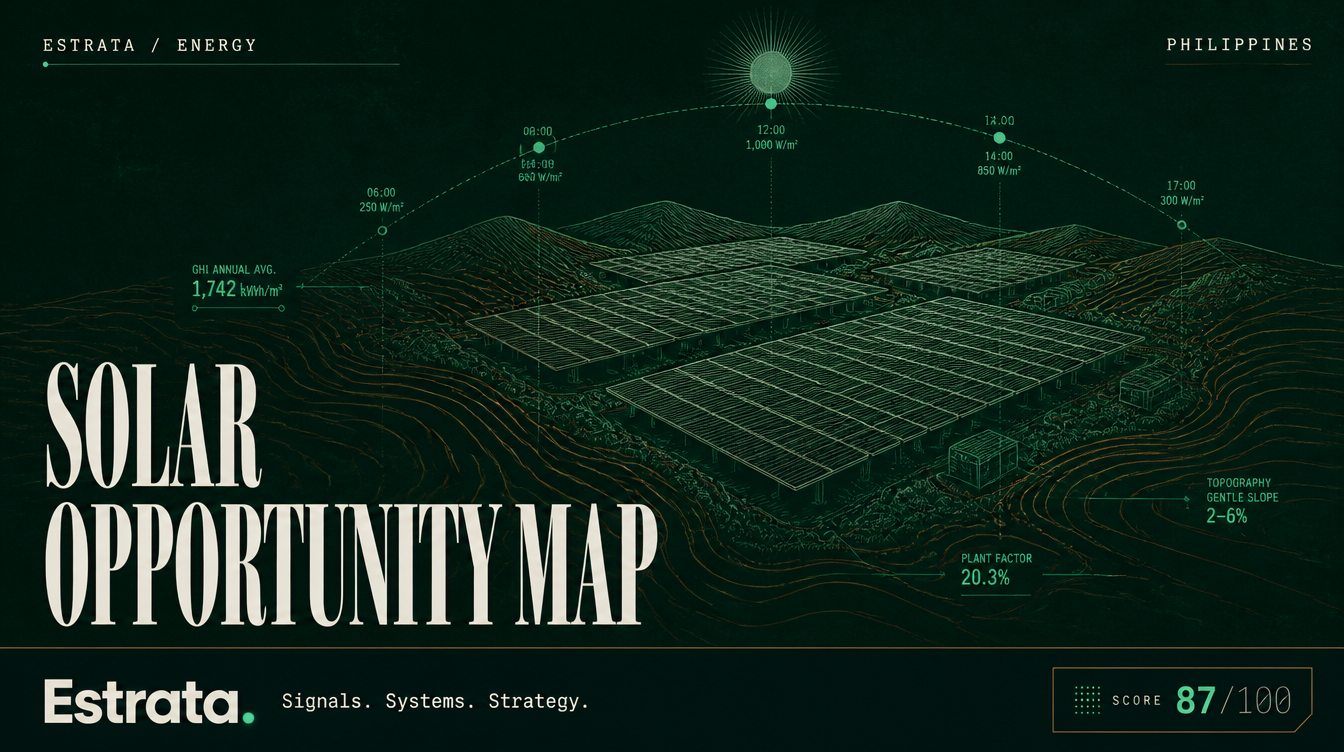
We score the opportunity it anchors, a Central Luzon solar-plus-storage corridor,
at 87/100 (scoring_version: 2026.1); the full factor breakdown and its risks
live in the backing
opportunity record (opp.solar-storage.central-luzon.001).
The Visayas, the widening frontier
The more strategically interesting movement is away from the Luzon megaproject narrative. In 2025, Aboitiz Renewables' 173 MWp Calatrava plant in Negros Occidental reached full commercial operation and became the largest operating variable-renewable installation on the Visayas grid.4 Two more Aboitiz plants, 211 MWp Olongapo (Zambales) and 89 MWp San Manuel (Pangasinan), were in commissioning or construction by late 2025.4
Our read: the Visayas matters out of proportion to its megawatts. A 173 MWp plant being the regional record tells you the Visayas grid is early on its build-out curve, which is precisely where a developer or supplier finds room that Luzon's crowded, banked pipeline no longer offers.
A note on the numbers
Headline capacity figures for Philippine solar do not fully agree, and we flag that rather than smooth it over. IRENA's tally put cumulative installed solar at 3,892 MW at end-2025 (up 899 MW on the year); DOE figures for ground-mounted (3,492 MW) plus behind-the-meter (52 MW) sum to 3,544 MW, a gap that reflects different counting conventions, not a factual error in either.5 For a map, the direction and concentration matter more than the third significant digit; where a single hard number is load-bearing, we cite the source so a reader can choose.
The opportunity, and who captures it
The investable opportunity in Philippine solar is less the marquee asset than the build-out it pulls. MTerra itself is effectively banked, locked under a 20-year, 850 MW power-supply agreement with Meralco held by SPNEC/MGEN and partner Actis.3 That is exactly why, in our scoring, the Central Luzon corridor's competition factor scores low even as scale and readiness score near-maximum: the flagship is spoken for.6
The alpha sits one layer out, in the second-order demand a 9.4 GW auction creates:
- EPC and equipment supply for dozens of GEA-4 projects (MTerra's own EPC is China Energy Engineering3): a recurring, multi-year procurement stream.
- Battery storage, which GEA-4 elevates from optional to structural with its dedicated 1,100 MW solar-plus-storage allocation.1
- Transmission and interconnection, the genuine bottleneck (see What to watch).
- The Visayas and secondary Luzon provinces, where the connect-able headroom is larger than in the contested Luzon core.
What to watch
- GEA-4 award prices and take-up. The TOR sets the volume; the awarded tariffs and how fully each regional lot fills will reveal where developers actually see returns.1
- Transmission, not panels. Concentrating multiple gigawatts of variable solar in Luzon corridors stresses the grid; NGCP's ability to evacuate that power (and the curtailment that follows if it can't) is the swing variable. A future Estrata grid analysis will map this directly.
- Storage attach-rates. Whether the 1,100 MW solar-plus-storage lot is fully subscribed signals how fast BESS becomes standard rather than premium.
- The Visayas curve. If a second plant overtakes Calatrava's 173 MWp regional record quickly, the frontier is opening faster than the headline Luzon numbers suggest.
Sources
- DOE, Philippines opens Green Energy Auction 4 (12 Mar 2025): GEA-4 volumes and regional/year lots. https://legacy.doe.gov.ph/press-releases/philippines-opens-green-energy-auction-4-integrating-energy-storage-sustainable
- DOE, Secretary Lotilla welcomes landmark investment in Terra Solar (21 Nov 2024): MTerra capacity and Luzon-grid contribution. https://legacy.doe.gov.ph/press-releases/secretary-lotilla-welcomes-landmark-investment-renewable-energy-terra-solar
- Meralco PowerGen, MTerra Solar Project Breaks Ground (22 Nov 2024): investment figure, storage, offtake, EPC. https://www.meralcopowergen.com.ph/mterra-solar-project-breaks-ground-a-monumental-milestone-in-the-philippines-renewable-energy-transition/
- CleanTechnica, Largest Solar Energy Projects in the Philippines (1 Oct 2025): Calatrava / Olongapo / San Manuel capacities and status. https://cleantechnica.com/2025/10/01/largest-solar-energy-projects-in-the-philippines-online-and-in-the-pipeline/
- IRENA / DOE capacity figures (end-2025), via pv magazine (20 Apr 2026). https://www.pv-magazine.com/2026/04/20/philippines-adds-899-mw-of-solar-in-2025/
Primary document (attached below): DOE, GEA-4 Notice of Auction (11 Jun 2025),
the official auction notice underlying the GEA-4 figures above
(src.doe.notice-of-auction.2025-06-11.0001).
Backing structured records (provenance trail): signals
sig.policy.2025-03-12.0001, sig.energy.2024-11-21.0001,
sig.energy.2025-10-01.0001; opportunity opp.solar-storage.central-luzon.001
(score 87, scoring_version: 2026.1).
Estrata provides research and analysis for informational purposes only. It is not financial, investment, legal, or tax advice and is not a recommendation to buy or sell any security or asset. Figures are drawn from public sources and may contain errors; verify independently before making decisions.
Footnotes
-
DOE GEA-4 press release, 12 Mar 2025 (
src.doe.press.2025-03-12.0001). ↩ ↩2 ↩3 ↩4 ↩5 ↩6 ↩7 -
DOE press release, 21 Nov 2024 (
src.doe.press.2024-11-21.0001). ↩ ↩2 -
Meralco PowerGen, 22 Nov 2024 (
src.meralcopowergen.press.2024-11-22.0001). ↩ ↩2 ↩3 ↩4 -
CleanTechnica, 1 Oct 2025 (
src.cleantechnica.web.2025-10-01.0001). ↩ ↩2 ↩3 -
IRENA cumulative (3,892 MW end-2025; +899 MW YoY) vs DOE components (3,492 MW ground-mounted + 52 MW behind-the-meter), via pv magazine, 20 Apr 2026. ↩
-
Opportunity
opp.solar-storage.central-luzon.001, score 87,scoring_version: 2026.1. ↩