Indonesia's Nickel Quota Cut Is Repricing Philippine Ore, and Testing a Stalled $12-Billion Processing Bet
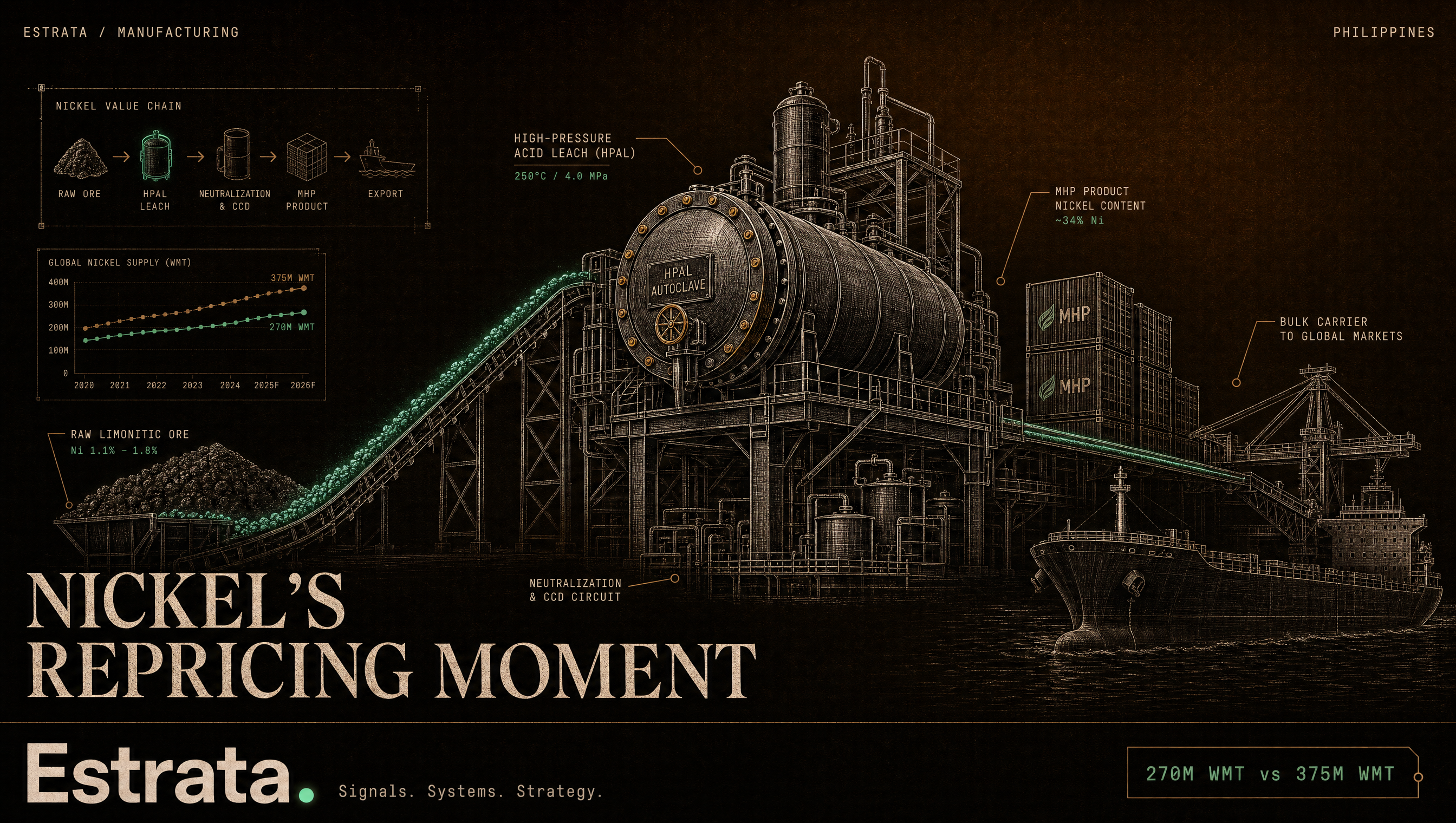
Indonesia cut its 2026 nickel mining quota by roughly a third, flipping a global surplus into a projected deficit and pushing Indonesian and Chinese-linked smelters to bid up Philippine ore. The Philippines is capturing the price windfall today. Whether it finally builds the downstream processing plants investors have floated since 2023 is a separate, unresolved question.
Key takeaways
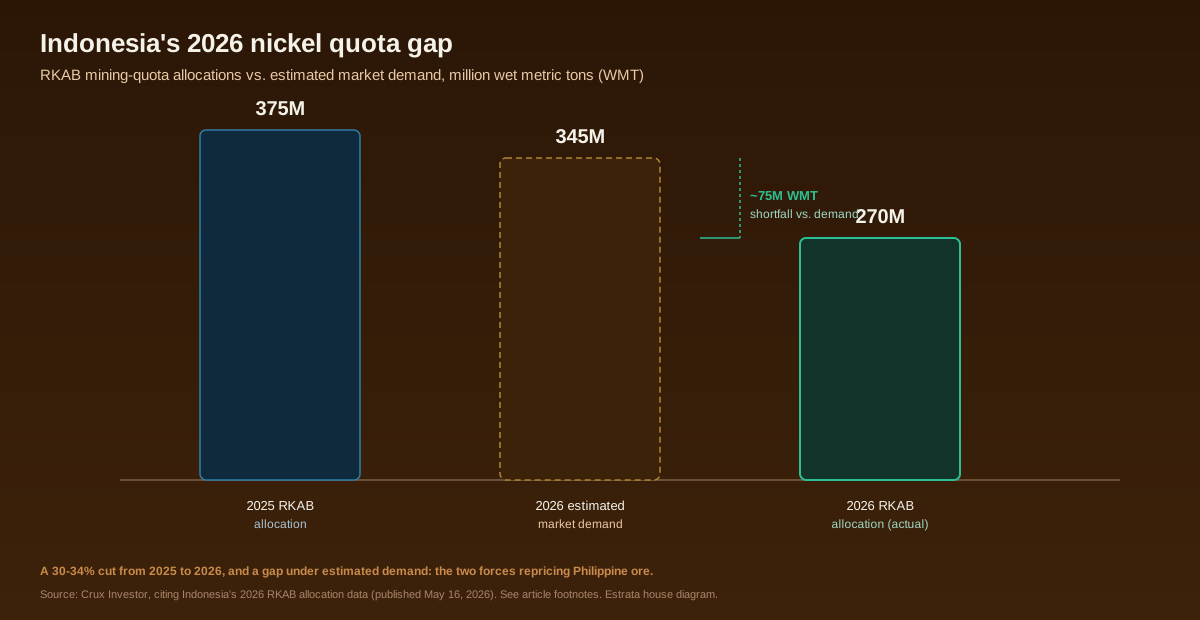
- Indonesia cut its 2026 nickel mining quota to roughly 270 million wet metric tons (WMT), down from 375 million WMT in 2025 and short of an estimated 345 million WMT in demand, a 30 to 34 percent contraction in authorized ore output.1 The move has helped flip a projected 283,000-tonne global surplus in 2025 into a projected 32,000-tonne deficit in 2026, alongside a 37 percent LME nickel price rally between December 2025 and April 2026.1
- Philippine ore is the direct beneficiary. Indonesian smelters facing their own domestic shortfall, many of them Chinese-financed, are now competing with traditional Chinese buyers for Philippine nickel ore, a structural shift in who holds pricing leverage between the world's two largest nickel suppliers.
- The Philippine Nickel Industry Association (PNIA) is framing this as vindication of its cooperation push with Indonesia's miners, pointing to the "IndoPhil Nickel Corridor" the two associations formalized earlier in 2026 as evidence the Philippines is a steadier long-term partner than a single country's annual quota cycle.2
- The unresolved question is downstream, not upstream. Roughly USD 12 billion in Philippine nickel-processing (HPAL) plants have been floated since 2023 and 2024 and remain unbuilt; higher ore prices help the economics but have not, on the public record, moved any of them past feasibility.34
What Indonesia actually changed
Indonesia's RKAB is the annual permit mechanism that sets how much nickel ore its miners can extract. For 2026, the government approved 270 million WMT, down sharply from 375 million WMT in 2025 and below the roughly 345 million WMT the market expected demand to require.1 That gap is doing the work: the International Nickel Study Group's 2026 projection swung from a 283,000-tonne surplus in 2025 to a 32,000-tonne deficit, and LME nickel prices rallied 37 percent from late December 2025 through April 2026.1 Indonesia controls roughly 60 percent of the world's nickel deposits and has tightened extraction policy in stages since its 2020 ore-export ban, each round pushing the market further toward state-managed scarcity.
Our read: this is not a one-off supply hiccup, it is the latest step in a multi-year Indonesian strategy to convert resource abundance into pricing power. Every prior tightening round, the export ban, the 2025 royalty reform, this year's quota cut, has moved the same direction. Investors should treat further tightening as the base case, not a tail risk.
Why the Philippines is capturing the windfall
The Philippines produces around 10 percent of global nickel output and holds the world's sixth-largest reserves by the US Geological Survey's count, with more than 70 percent of 2025's 67-million-WMT ore production coming from PNIA member companies.2 Indonesia and the Philippines together hold roughly 75 to 80 percent of the world's known nickel deposits, and the two countries' ore chemistry is complementary: Philippine laterite ore's silicon-to-magnesium ratio suits the battery-grade processing lines Indonesian smelters already run at scale.5 That is why Indonesian, not just Chinese, buyers are now bidding for Philippine cargo: a domestic quota cut does not shrink Indonesian smelter capacity, so the shortfall gets filled with imported ore.
PNIA President Dante Bravo put the industry's read on the record this week: "Indonesia's quota decisions each year are a reminder of a simple fact: global nickel supply cannot responsibly rest on a single country's policy calendar."2 That statement leans on cooperation the two countries' mining associations built earlier in 2026: PNIA and Indonesia's APNI signed a five-pillar cooperation MOU in February, then broadened it in May into a government-witnessed "IndoPhil Nickel Corridor" alongside both countries' chambers of commerce.65
Our read: the corridor is genuine industry coordination, not a supply cartel with enforcement teeth, since neither association sets national quota policy. Its real function is signaling: it gives Philippine officials and miners a platform to court capital that might otherwise wait out Indonesia's next RKAB cycle, and it gives Bravo's quote more weight than an opportunistic press line would carry alone.
The part of the story that has not moved
Higher ore prices are a real benefit to Philippine miners exporting raw material. They are not the same thing as the country finally capturing processing margin. Since 2023, Nickel Asia Corp. and Global Ferronickel Holdings have each floated roughly USD 1 billion HPAL (high-pressure acid leach) plants, in Davao Oriental and Surigao respectively, and by 2024 the Board of Investments was citing a pipeline of three new HPAL facilities across Zambales, Surigao and Palawan worth a combined USD 12 billion.34 None of that has a confirmed construction start, financial close, or updated capex figure in the public record as of this article. The Philippines still operates only two HPAL plants, and roughly 95 percent of its nickel ore is exported raw.
Our read: a price rally driven by an Indonesian supply cut is exactly the kind of catalyst that could unstick a stalled HPAL decision, since higher long-run ore prices improve the return math on a plant that takes years to permit and build. But price alone has not been the constraint since 2023; power costs, permitting timelines, and financing have. Until one of the announced projects reaches financial close, this remains an upstream repricing story, not a processing build-out.
What to watch
Three signals would confirm this moves from commodity windfall to structural shift: a specific HPAL project (Nickel Asia, Global Ferronickel, or a new entrant) announcing financial close or groundbreaking; Indonesia's 2027 RKAB allocation, which will show whether 2026's cut was a one-year correction or the start of a sustained tightening cycle; and any Philippine government incentive package (beyond the Green Lane fast-track and existing income-tax holidays already on the books) specifically aimed at closing the financing gap on domestic nickel processing. Absent those, the more probable near-term outcome is simply that Philippine miners sell more ore at better prices, a real but modest win compared with the downstream industrial upgrade officials have been describing since 2023.
Footnotes
-
Crux Investor, "Indonesia's 2026 Policy Tightening Has Repriced the Nickel Cost Map": May 16, 2026. Indonesia's 2026 RKAB allocation of 270 million WMT versus 375 million WMT in 2025 and roughly 345 million WMT in expected demand; LME nickel price rally of 37 percent from late December 2025 to April 2026; International Nickel Study Group 2026 projection of a 32,000-tonne deficit, reversed from a 283,000-tonne surplus in 2025. https://www.cruxinvestor.com/posts/indonesias-2026-policy-tightening-has-repriced-the-nickel-cost-map ↩ ↩2 ↩3 ↩4
-
Mindanao Times, "Philippines positions as stable critical minerals partner as Indonesia recalibrates nickel supply policy": July 15, 2026. Philippines at approximately 10 percent of global nickel output, world's sixth-largest reserves per USGS 2025 Mineral Commodity Summary, 67 million WMT of 2025 ore production with over 70 percent from PNIA member companies; quotes PNIA President Dante Bravo. https://www.mindanaotimes.com.ph/philippines-positions-as-stable-critical-minerals-partner-as-indonesia-recalibrates-nickel-supply-policy/ ↩ ↩2 ↩3
-
MINING.COM, "Top Philippine nickel miners may spend $2 billion in new plants": September 21, 2023. Nickel Asia Corp. (~USD 1 billion, 30,000-MT HPAL plant, Pujada peninsula, Davao Oriental) and Global Ferronickel Holdings (~USD 1 billion, ~40,000-MT first HPAL facility, southern Surigao) plans, both subject to feasibility studies and unconfirmed as built. https://www.mining.com/web/top-philippine-nickel-miners-may-spend-2-billion-in-new-plants/ ↩ ↩2
-
Philippine Resources Journal, "BOI sees 3 more nickel processing plants in PH by 2028": May 13, 2024. Board of Investments managing head Ceferino Rodolfo citing three planned HPAL plants in Zambales, Surigao and Palawan worth a combined USD 12 billion, against two existing plants at the time. https://www.philippine-resources.com/articles/2024/5/boi-sees-3-more-nickel-processing-plants-in-ph-by-2028 ↩ ↩2
-
BusinessMirror, "PHL, Indonesia set up 'nickel' corridor": May 8, 2026. Indonesia holding roughly 60 percent of world nickel deposits and the Philippines about 15 percent, combined 75 to 80 percent; Philippine ore's silicon-to-magnesium ratio complementing Indonesian battery-grade processing; May 7, 2026 Lapu-Lapu City ceremony broadening cooperation between PNIA, Kadin Indonesia, and the Philippine Chamber of Commerce and Industry. https://businessmirror.com.ph/2026/05/08/phl-indonesia-set-up-nickel-corridor/ ↩ ↩2
-
Philippine Nickel Industry Association, "Indonesia and Philippine Nickel Miners Launches IndoPhil Nickel Corridor for Responsible Mining": published February 23, 2026, documenting the February 12, 2026 signing at the University of Asia and the Pacific of a five-pillar PNIA-APNI cooperation MOU on data sharing, industry dialogue, learning exposure, ESG capability development, and adaptive cooperation. https://www.philippinenickel.org/news-and-updates/press-release/indonesia-and-philippine-nickel-miners-launches-indophil-nickel-corridor-for-responsible-mining/ ↩