A Shock Absorber for Geothermal Risk: Inside the Philippines' PHP 10.07-Billion Derisking Facility
The Philippine Geothermal Resource Derisking Facility cleared its final government approval on July 7, 2026: a PHP 10.07-billion (USD 170 million), ADB-backed mechanism that pays over half the cost of exploration drilling and only asks developers to repay it if the resource proves real. That is a direct answer to the industry's long-standing complaint that dry-hole risk, not resource scarcity, has kept new geothermal fields undeveloped.
Key takeaways
- Final government sign-off landed July 7, 2026. The Economy and Development (ED) Council, chaired by President Marcos, gave final approval to the Philippine Geothermal Resource Derisking Facility (PGRDF), a PHP 10.07-billion (USD 170 million) mechanism financed through an Asian Development Bank (ADB) sovereign loan, alongside four other public investment projects.1
- The mechanism is the real news. The facility covers at least 50 percent of exploration and drilling costs through a conditionally repayable grant: developers repay it only if the resource proves viable, and it converts to a forgiven grant if the well is dry.2 That is a direct transfer of exploration risk from developer to state, not just cheaper financing.
- The facility has technically existed since December 2025. The Department of Energy (DOE) and the Land Bank of the Philippines (LANDBANK) signed the operationalizing memorandum of agreement (MOA) on December 16, 2025, targeting availability in the first quarter of 2026.23 July's ED Council vote is a separate, higher-level public investment clearance, not the facility's actual launch.
- The industry asked for exactly this. The National Geothermal Association of the Philippines (NGAP) publicly welcomed the approval, and the Philippines, which installed 1,952 MW of geothermal capacity in 2024 and once ranked second globally before Indonesia overtook it in 2018, has a long-term DOE capacity-addition target that Estrata has previously reported at just 288 MW through 2030, a modest number a working de-risking pipeline could accelerate.234
What the facility actually pays for
Geothermal exploration is capital destruction until it isn't. A developer has to drill wells to confirm a resource exists, at what temperature, and at what flow rate, all before a single megawatt is contracted. A dry well consumes years of drilling investment and returns nothing. That asymmetry, large guaranteed cost against uncertain payoff, is what has kept new (as opposed to brownfield-adjacent) geothermal development concentrated among a handful of incumbents with balance sheets big enough to absorb a bad well.
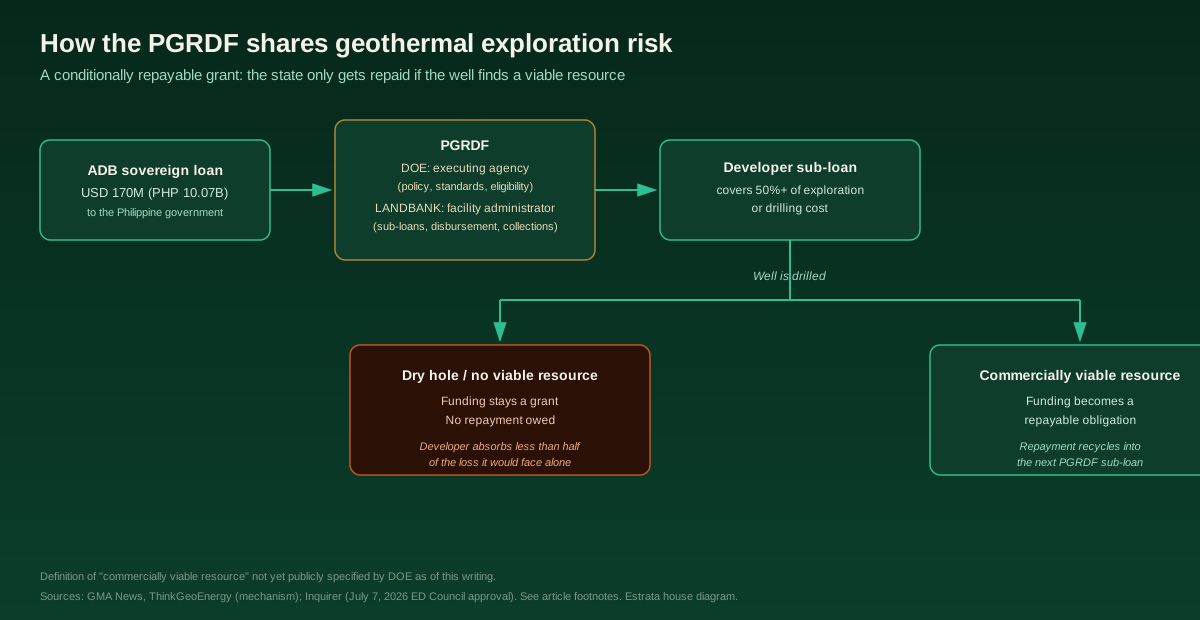
The PGRDF's design targets that asymmetry directly rather than just subsidizing it. Through LANDBANK sub-loans, the facility shoulders at least 50 percent of exploration or drilling costs as a "conditionally repayable grant": if the drilling confirms a commercially viable resource, the funding is treated as an obligation the developer repays; if it doesn't, the funding is written off as a grant, no repayment owed.23 DOE acts as executing agency, setting policy direction, technical standards, and eligibility criteria; LANDBANK administers the money itself, handling sub-loan applications, milestone-based disbursement, and collections.2
Our read: this is a genuine risk transfer, not a rate subsidy. A developer facing a dry hole under PGRDF loses less than half of what it would have lost alone; a developer that finds a viable resource pays the money back, so the facility recycles capital rather than spending down to zero. That structure is what lets the same PHP 10.07-billion pool underwrite far more exploration attempts than a straight grant program of the same size would.
Two approvals, seven months apart
The PGRDF's timeline has two distinct milestones that are easy to conflate. DOE and LANDBANK signed the operationalizing MOA on December 16, 2025, the document that actually stood up the facility's mechanics and targeted a first-quarter 2026 start date.23 The July 7, 2026 vote reported this week is a different, later step: the ED Council, the Marcos administration's inter-agency body for clearing major public investment projects, gave the PGRDF (alongside LRT-1's Common Station, a TESDA training program, a DPWH seismic retrofit, and a DICT AI infrastructure master plan) its formal public-investment sign-off.1
Our read: a facility that was operationally "live" since Q1 2026 but only received top-level investment clearance in July raises a fair question about how much capital, if any, has actually moved through LANDBANK's sub-loan pipeline in the intervening six months. None of this week's coverage names a first drawdown, a first participating developer, or a disbursed peso figure. Until one of those appears, the PGRDF should be read as a fully designed and now fully cleared mechanism, not yet a mechanism with a demonstrated track record.
Why exploration risk was the actual constraint
The Philippines sits on one of the world's largest geothermal resource bases and has for decades, yet new development has lagged the resource. The country installed 1,952 MW of geothermal capacity as of 2024 and held the world's number-two ranking for installed capacity until Indonesia passed it in 2018.32 Estrata has previously reported DOE's long-term roadmap targeting just 288 MW of further additions between 2026 and 2030 (see our prior report on EDC's drilling program), a fraction of the multi-gigawatt volumes contracted annually for solar under the Green Energy Auction Program. Existing operators like Energy Development Corporation (EDC) have concentrated on brownfield drilling campaigns on already-producing fields precisely because that risk profile is manageable, while genuinely new sites stay stranded.
NGAP, the professional association for the sector, called the PGRDF a "landmark initiative" and pledged support for its implementation, a signal that the mechanism is aimed at the industry's actual bottleneck rather than a political talking point.4 DOE Undersecretary Rowena Cristina Guevara framed the goal explicitly as pipeline expansion: "by de-risking exploration and enabling more projects to move from uncertainty to confirmation, we are widening the pipeline."2
Our read: the entities best positioned to benefit first are incumbents like EDC and Aboitiz Power's AP Renewables, which already have the technical staff and permitting relationships to move quickly on new sub-loan applications, even though the facility's stated purpose is to widen the field beyond them. Whether PGRDF actually pulls in new entrants, rather than simply cheapening the next well for existing players, is the detail that will determine if this becomes a structural unlock or an incumbent subsidy.
What to watch
Three unresolved details determine whether the PGRDF changes geothermal's investment math or just improves it at the margin. First, DOE has not publicly defined the threshold for a "commercially viable resource" that converts the grant into a repayable obligation; that definition, once written into program rules, sets the real risk-sharing ratio. Second, no developer, greenfield site, or disbursed amount has been named yet, so the facility's actual uptake is unverified. Third, PGRDF only covers the exploration and drilling stage; turning a confirmed resource into contracted capacity still requires the multi-year permitting, financing, and construction process that has separately slowed projects like EDC's ongoing drilling campaigns. A de-risked front door does not guarantee a faster back end.
Footnotes
-
Philippine Daily Inquirer, "Marcos-led ED Council clears LRT-1 Common Station, 4 projects": July 7, 2026 ED Council approval of five projects including the PHP 10.07-billion, ADB-backed PGRDF, alongside LRT-1 Common Station, TESDA's BEST program (PHP 15.76B), DPWH's seismic resilience retrofit, and DICT's AI infrastructure master plan. https://business.inquirer.net/599327/marcos-led-ed-council-clears-lrt-1-common-station-4-projects ↩ ↩2
-
GMA News Online, "DOE, Landbank to operationalize 'de-risking' facility for geothermal exploration": December 16, 2025 DOE-LANDBANK MOA; USD 170M ADB sovereign loan; conditionally repayable grant mechanism covering at least 50 percent of exploration/drilling cost; DOE as executing agency, LANDBANK as facility administrator; Q1 2026 targeted availability; 1,952 MW installed geothermal capacity (2024); quote from DOE Usec. Rowena Cristina Guevara. https://www.gmanetwork.com/news/money/companies/969816/doe-landbank-to-operationalize-de-risking-facility-for-geothermal-exploration/story/ ↩ ↩2 ↩3 ↩4 ↩5 ↩6 ↩7 ↩8
-
ThinkGeoEnergy, "$170m geothermal de-risking facility in the Philippines officially launched": confirms USD 170M total facility size (raised from an initial USD 100M target), ADB sovereign loan structure, conditionally-repayable-grant mechanism, Q1 2026 availability, and the Philippines' former number-two global ranking in installed geothermal capacity before Indonesia overtook it in 2018; quote from Energy Secretary Sharon Garin. https://www.thinkgeoenergy.com/170m-geothermal-de-risking-facility-in-the-philippines-officially-launched/ ↩ ↩2 ↩3 ↩4 ↩5
-
BusinessMirror, "Geothermal practitioners back PGRDF": National Geothermal Association of the Philippines (NGAP) welcoming the July 7, 2026 final approval; quote from NGAP President Jaime Jemuel Austria. https://businessmirror.com.ph/2026/07/08/geothermal-practitioners-back-pgrdf/ ↩ ↩2