The Energy Emergency Is Fading. The Policy Shift It Forced Isn't.
Executive Order 110 declared a national energy emergency in March after the Strait of Hormuz closed off a fifth of the world's oil. Hormuz has reopened faster than forecast and crude is sliding toward Citigroup's projected $60 floor, but a spot-market suspension precedent, a diversified crude supply chain, and an accelerated storage mandate look like they will outlast the crisis that produced them.
Key takeaways
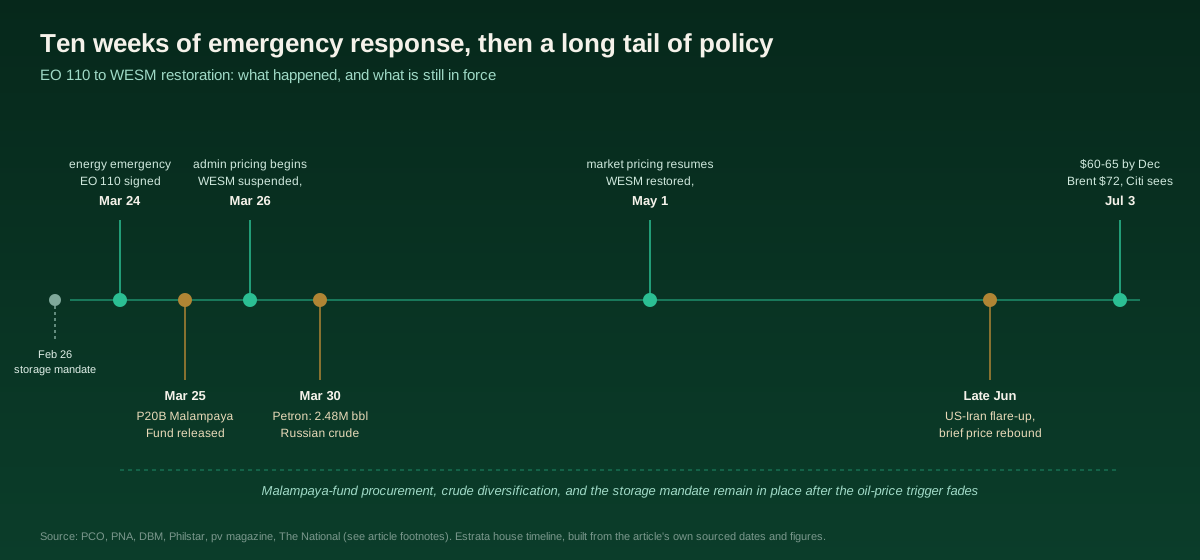
- EO 110 declared a one-year emergency, not a one-week one. President Marcos signed the order on March 24, 2026 after a US-Israel war on Iran closed the Strait of Hormuz, the chokepoint for roughly a fifth of the world's seaborne oil, while the Philippines was sourcing 98 percent of its crude from Middle East suppliers. The order runs through March 2027 unless lifted or extended sooner.12
- The DOE actually suspended the spot market. On March 26 the Wholesale Electricity Spot Market was suspended across all three grids and replaced with Modified Administered Pricing to head off a spike regulators projected could add P2 to P4 per kilowatt-hour. The ERC restored market pricing on May 1.3
- Two supply-chain moves outlived the panic that created them. DBM released P20 billion from the Malampaya Fund for PNOC-EC to buy fuel directly, and Petron secured 2.48 million barrels of Russian crude for its Bataan refinery under a now-lapsed US Treasury waiver, both durable additions to the state's emergency toolkit.45
- Oil is normalizing faster than the policy response is unwinding. Brent closed at $72.12 and WTI at $68.78 on July 3 as Hormuz shipping recovered, with Citigroup projecting Brent in a $60-$65 range by December, yet a late-June flare-up in US-Iran tensions briefly reignited the same fuel-price volatility EO 110 was written to contain.67
An emergency built for intervention
EO 110 did more than declare concern. It activated UPLIFT (Unified Package for Livelihoods, Industry, Food, and Transport), gave the Department of Energy emergency procurement and market-intervention authority, and set a one-year clock that lapses in March 2027 unless the president acts sooner.1 The DOE used that authority within 48 hours: the WESM suspension on March 26 replaced market-clearing prices with administered pricing (coal capped, negative pricing zeroed out) specifically to prevent the P2-to-P4-per-kWh spike regulators were modeling.3 The intervention lasted five weeks. The ERC restored the spot market on May 1, with commission chair Francis Saturnino Juan framing the return to market pricing as compatible with keeping "consumer protection safeguards" in place.3
Our read: the substantive precedent is not the five weeks of administered pricing, it is that the state now has a demonstrated, tested playbook for suspending the spot market on short notice during a supply shock. Any generator or trader underwriting merchant WESM exposure has to price in an intervention risk that, before March 2026, existed only on paper.
What the panic bought that outlasts the panic
Two of the emergency's responses are structural rather than one-off. First, DBM's P20 billion Malampaya Fund release on March 25 gave PNOC Exploration Corporation a direct-procurement channel, buying diesel, gasoline, and LPG to build a strategic reserve that bypasses the private supply chain when it is under stress.4 Second, Petron, after losing access to roughly four million barrels of Middle East crude in an eight-day span in February, secured 2.48 million barrels of Russian ESPO crude for its Bataan refinery, delivered via the tanker Sara Sky under a US Treasury sanctions waiver that has since expired.5 That shipment was a one-time workaround, but it proved the refinery can run on a non-benchmark, non-Middle-East crude slate when it needs to, a capability the country had not exercised at this scale before.
A third change predates the crisis but was hardened by it: the DOE's February 26 circular requiring new variable renewable plants above 10 MW to pair with storage equal to at least 20 percent of installed capacity, plus grid-forming inverter capability.8 The mandate was written as a grid-integration measure. By the time EO 110 had made "energy security" a declared state of emergency, walking the storage requirement back became politically much harder.
Our read: the durable assets for investors to price are PNOC-EC's expanded procurement mandate, Petron's proven crude-diversification option, and a storage requirement that now carries emergency-era political cover. All three should survive even if EO 110 is allowed to quietly lapse next March.
Risks and what to watch
Oil markets are telling the opposite story at the trigger level. Hormuz shipping has recovered faster than forecast: UAE crude exports through the Habshan-Fujairah bypass pipeline rose nearly 30 percent in June to near their highest level since 2017, and Citigroup is now calling for Brent to fall into a $60-$65 range by December as the market moves into contango on a widening supply surplus.6 That is the case for a quiet, unremarked unwind of the emergency measures over the next two quarters.
But the last week of June was a reminder of how thin that recovery is. Fresh US-Iran military exchanges briefly reignited fears of renewed Strait disruption and slowed shipping again, whipsawing the DOE's own weekly pump-price adjustment band in the same week global oil had been rolling back.7 The 98-percent Middle East import dependency that triggered EO 110 in the first place is unchanged; only the price of that exposure has temporarily fallen. Watch three things: whether Marcos extends, narrows, or formally lifts EO 110 before March 2027; whether Petron and other refiners keep sourcing non-Middle-East crude as standing policy now that the Treasury waiver has lapsed; and whether the DOE codifies its WESM-suspension trigger into standing regulation rather than leaving it as one-off executive action, since any renewed Strait closure would retest the same playbook within months of its first use.
Footnotes
-
Presidential Communications Office: "President Marcos declares State of National Energy Emergency; activates UPLIFT as Whole-of-Government Response Framework": EO 110 signed, national energy emergency triggered by Middle East conflict, UPLIFT framework, one-year duration unless extended or lifted. https://pco.gov.ph/news_releases/president-marcos-declares-state-of-national-energy-emergency-activates-uplift-as-whole-of-government-response-framework/ ↩ ↩2
-
Rappler: "Fuel price rollback or increase on June 30 as Middle East tensions return": Philippines imports 98 percent of its oil from the Middle East; Strait of Hormuz carries roughly one-fifth of global oil supply. https://www.rappler.com/business/fuel-prices-adjustments-june-30-2026/ ↩
-
Bilyonaryo: "ERC lifts power spot market suspension in all grids effective May 1": WESM suspended March 26 amid a projected P2-P4/kWh spike risk; ERC restored market pricing May 1; quote from ERC Chair Francis Saturnino Juan. https://bilyonaryo.com/2026/05/01/erc-lifts-power-spot-market-suspension-in-all-grids-effective-may-1/power/ ↩ ↩2 ↩3
-
Philippine News Agency: "PBBM orders release of P20-B emergency fund to secure PH fuel supply": P20 billion released from the Malampaya Fund on March 25, 2026, to PNOC Exploration Corporation for direct fuel procurement (diesel, gasoline, LPG). https://www.pna.gov.ph/articles/1271722 ↩ ↩2
-
Philstar: "Petron confirms 2.48M barrels of Russian oil purchased, says it may buy more": Petron lost access to about four million barrels of Middle East crude in an eight-day span; secured 2.48 million barrels of Russian ESPO crude via the tanker Sara Sky, delivered to Limay, Bataan, under a US Treasury waiver issued March 12 and valid until April 11. https://www.philstar.com/business/2026/03/30/2517869/petron-confirms-248m-barrels-russian-oil-purchased-says-it-may-buy-more ↩ ↩2
-
The National: "Oil heads for fourth weekly loss as Strait of Hormuz shipping recovery erases war premium": Brent at $72.12/barrel and WTI at $68.78/barrel as of July 3, 2026; UAE exports through the Habshan-Fujairah bypass pipeline up nearly 30 percent in June; Citigroup forecasting Brent in a $60-$65 range by December amid a shift to contango. https://www.thenationalnews.com/business/energy/2026/07/03/oil-heads-for-fourth-weekly-loss-as-strait-of-hormuz-shipping-recovery-erases-war-premium/ ↩ ↩2
-
Rappler: "Fuel price rollback or increase on June 30 as Middle East tensions return": renewed US-Iran military exchanges reignited fears of Strait of Hormuz disruption and slowed shipping in late June, ahead of a fragile truce restoring earlier price declines. https://www.rappler.com/business/fuel-prices-adjustments-june-30-2026/ ↩ ↩2
-
pv magazine: "Philippines mandates energy storage for renewables plants over 10 MW": DOE circular issued February 26, 2026, requiring new variable renewable energy plants above 10 MW to add storage equal to at least 20 percent of installed capacity, with grid-forming inverter capability. https://www.pv-magazine.com/2026/02/27/philippines-mandates-energy-storage-for-renewables-plants-over-10-mw/ ↩