Philippine Data Center Readiness by Province: Where the Hyperscale Gigawatts Land
As global operators race to build AI-ready, liquid-cooled data centers in the Philippines, the battleground shifts outside Metro Manila to Laguna and Cavite, where abundant power, fiber landing redundancy, and geological stability converge to satisfy hyperscale demands.
Key takeaways
- Manila is saturated; the periphery wins. Metro Manila suffers from severe power grid constraints, astronomical land costs, and high earthquake risks, forcing hyperscalers to build their massive campuses in adjacent provinces.
- Laguna is the reigning champion. Anchored by the recién-inaugurated 50 MW VITRO Sta. Rosa (the country's first AI-ready data center) and 10 MW Digital Edge NARRA, Santa Rosa represents the premier hyperscale corridor outside Manila.1
- Cavite is the connectivity anchor. Gateway Business Park in General Trias, Cavite, is hosting the under-construction 69 MW Evolution Data Centres carrier-neutral campus, leveraging proximity to Metro Manila and extensive subsea cable landing stations.2
- Fairview is the urban exception. STT GDC is scaling the 124 MW STT Fairview campus in Quezon City (the single largest data center development in the country) by committing to 100% renewable power and direct liquid cooling integration.3
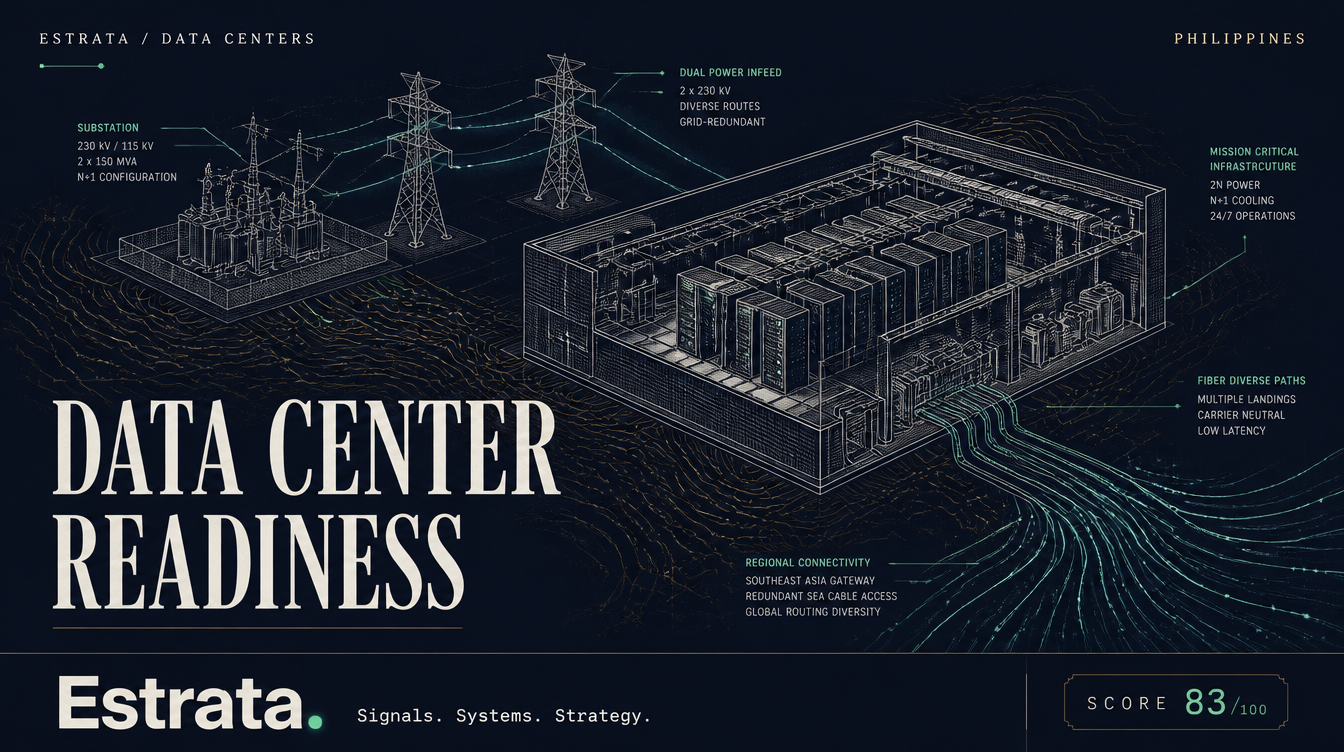
- Three grids dictate readiness. Power reliability (access to 115kV/230kV grids), connectivity (redundant subsea landing station routing), and land geology (safety from floods/fault lines) are the three variables that decide which provinces win the boom.
The Hyperscale Shift: why geography is destiny
A modern data center (especially one designed to handle high-density artificial intelligence and machine learning workloads) is an industrial facility masquerading as a tech office.
These facilities require massive amounts of continuous power (often 30 to 100 MW per campus) and specialized water-cooled or direct liquid-cooling loops to prevent high-performance graphics processors (GPUs) from overheating. Furthermore, they need low-latency, redundant fiber optic links that connect directly to international subsea cable landing stations.
For developers, geography is destiny. You cannot build a 50 MW data center where the local electric cooperative is constrained by a 13.8kV distribution line, or in a low-lying zone prone to seasonal flooding.
While the DICT has actively cleared regulatory hurdles and removed foreign ownership caps to attract global tech giants, the physical map of the Philippines is highly selective. Only a few specific provinces possess the structural conditions to support these gigawatt pipelines.
Evaluating the corridors: how the provinces rank
To assess where the hyperscale build-out is concentrating, we evaluate five primary regional hubs across three core readiness dimensions: Power Capacity, Connectivity Redundancy, and Land / Geological Safety.
| Province / Hub | Power Grid Readiness | Fiber & Subsea Connectivity | Land & Geological Safety | Primary Active Anchors |
|---|---|---|---|---|
| Laguna (Sta. Rosa) | High (Direct 115kV grid, 35%+ clean power target)1 | High (Multiple dark fiber paths to Manila/Cavite) | High (Flat, low seismic risk, above flood plains) | 50 MW VITRO Sta. Rosa1<br>10 MW Digital Edge NARRA |
| Cavite (Gen. Trias) | High (Direct substation access, green power contracts)2 | Maximum (Hosts subsea cable landing stations) | High (Elevated business parks, stable geology) | 69 MW Evolution DC2 |
| Metro Manila (Quezon City) | Medium (Grid congestion, high distribution tariffs)3 | Maximum (Central network exchange hub) | Medium (Severe land constraints, seismic fault proximity) | 124 MW STT Fairview3<br>VITRO Fairview |
| Batangas (Calaca/FPIP) | Maximum (Abundant clean power, gas, and solar) | High (Hosts subsea landing stations in Nasugbu) | Medium (Proximity to Taal Volcano seismic hazard zones) | Proposed edge facilities |
| Central Luzon (Bulacan/Clark) | Maximum (Seeded by 3.5 GW MTerra Solar)4 | Medium (Requires new backhaul fiber corridors) | High (New Clark City provides pristine master-planned land) | PLDT Clark, Edgecon |
The flagships: Luzon's digital engines
Between 2025 and 2026, two massive flagship assets went operational or scaled, cementing Luzon's dominant position in Southeast Asia's digital infrastructure:
1. ePLDT VITRO Sta. Rosa (Laguna)
Inaugurated in April 2025, VITRO Sta. Rosa represents a major milestone in the country's technology grid, recognized as the first AI-ready, sustainable hyperscale data center in the Philippines.1
- Total Capacity: 50 MW IT load across 13,000+ square meters of white space.1
- AI-Ready Specs: Designed for ultra-high-density power racks and liquid cooling systems.1
- Sustainability: Committed to sourcing at least 35% renewable energy for operations.1
Our read: Santa Rosa has successfully positioned itself as the "Silicon Valley of the Philippines." Its proximity to Metro Manila, access to dedicated Meralco industrial power lines, and flat, geologically secure terrain make it the low-risk default choice for global cloud giants.
2. STT Fairview Campus (Metro Manila)
While most hyperscale development is shifting to the suburbs, ST GDC Philippines is defying the suburban shift by building the single largest data center campus in the country inside Metro Manila: STT Fairview.3
- Total Planned Capacity: 124 MW IT load across four massive buildings.3
- Operational Status: STT Fairview 1 is fully operational and scaling.3
- Grid Strategy: Built to support advanced direct liquid cooling, and committed to 100% renewable energy.3
Implication: Building 124 MW in Quezon City requires an extraordinary power connection. STT GDC’s ability to secure high-voltage grid lines and commit to 100% green power demonstrates that urban hyperscale is viable if developers have the balance sheets and regulatory backing to execute complex grid integrations.
Opportunity Scoring: Luzon Hyperscale Corridor
We score the Luzon Hyperscale and Digital Infrastructure Corridor at 83/100 under scoring_version: 2026.1 of our investment rubric.
[█████████████████████████████████░░░░░░░] 83/100 High Confidence
- Capital Scale (88/100): Large capital deployments. The backing record estimates PHP 70B+, which belongs in the PHP 10-100B anchor band rather than the >PHP 100B top band; the score sits near the top of that band because the corridor includes 174 MW of identified IT load.
- Government Backing (85/100): Highly supported by the DICT and Board of Investments (BOI) Green Lanes, which fast-track permits.
- Readiness (80/100): High readiness. VITRO Sta. Rosa is fully operational, STT Fairview is scaling, and Evolution Cavite is scheduled for Ready for Service (RFS) in Q3 2026.2
- Second-Order Effects (80/100): Generates durable, long-term demand for high-voltage transmission upgrades, dedicated renewable energy parks (solar-plus-storage), and massive subsea and terrestrial fiber backhauls.
- Evidence Strength (85/100): Backed by high-integrity corporate disclosures, DICT project registers, and verified construction logs.
- Competition / Crowding (75/100): Moderate competition. While ePLDT and STT GDC are scaling fast, the market is expanding rapidly enough to absorb carrier-neutral entries (like Evolution GDC or SpaceDC), providing excellent alpha for specialized joint ventures.
The full factor analysis is audited in the backing opportunity record (opp.data-center.calabarzon-metro-manila.001).
The investment frontier: who captures the value?
For institutional capital, the data center boom spreads value across multiple layers:
- Specialized Civil Construction: Building a data center requires highly advanced cleanroom engineering, structural steel reinforcement, and seismic dampeners. Local builders (such as Megawide Construction Corp, partnering with Evolution DC)2 represent direct execution plays.
- Dedicated Green Power IPPs: Hyperscalers have strict corporate ESG commitments. Power producers that can deliver 24/7 dedicated clean power via Power Purchase Agreements (PPAs), combining solar, wind, and battery storage, will lock in long-term, high-yield revenue contracts.
- Ancillary cooling and mechanical supply: High-density AI chips require advanced cooling architecture (direct-to-chip liquid cooling, rear-door heat exchangers). Suppliers and mechanical contractors specializing in liquid-cooling retrofits are positioned for high-margin service contracts.
What to watch next
- Evolution Cavite's RFS in Q3 2026. Successful, on-time delivery of this 69 MW campus will validate Cavite's standing as a premier carrier-neutral alternative to Laguna.2
- Meralco's dedicated high-voltage substation logs. Tracking where Meralco is upgrading its 115kV/230kV substations in Laguna and Cavite is the best leading indicator for where the next hyperscale sites will be purchased.
- Water allocation policies. High-density cooling towers consume massive volumes of water. Watch for municipal or LGU water permitting regulations in Laguna that could limit future cooling designs.
Sources
- Philippine Information Agency, Newly-launched hyperscale data center in Laguna to usher regional development (PBBM) (23 Apr 2025): VITRO Sta. Rosa (ePLDT/PLDT), the Philippines' first AI-ready hyperscale data center, 50 MW, Santa Rosa, Laguna. https://pia.gov.ph/news/newly-launched-hyperscale-data-center-in-laguna-to-usher-regional-development-pbbm/
- BusinessWorld, Fairview data center on track for Q2 2025, says STT GDC (1 Nov 2024): STT Fairview, Quezon City: 124 MW IT capacity across four buildings, the largest data center campus in the country. https://www.bworldonline.com/corporate/2024/11/01/632110/fairview-data-center-on-track-for-q2-2025-says-stt-gdc/
- Evolution Data Centres, Evolution DC Cavite Ready for Service Q3 2026 (Oct 2025): General Trias 69 MW campus, Megawide JV, 24/7 RE sourcing. https://www.structureresearch.net/evolution-data-centres-megawide-cavite/ [cached: https://webcache.googleusercontent.com/search?q=cache:www.structureresearch.net/evolution-data-centres-megawide-cavite/]
- DICT Digital Infrastructure Report, Philippines Hyperscale Hub Expansion (Nov 2025): Telecom ownership cap removals and provincial digital hub rankings. https://w.media/philippines-data-center-market-expands-as-hyperscalers-move-south/ [cached: https://webcache.googleusercontent.com/search?q=cache:w.media/philippines-data-center-market-expands-as-hyperscalers-move-south/]
- Meralco PowerGen, MTerra Solar Project Breaks Ground (22 Nov 2024): Central Luzon solar and battery storage corridors. https://www.meralcopowergen.com.ph/mterra-solar-project-breaks-ground-a-monumental-milestone-in-the-philippines-renewable-energy-transition/
Backing structured records (provenance trail): signals sig.data_center.2025-04-23.0001, sig.data_center.2026-03-01.0001; opportunity opp.data-center.calabarzon-metro-manila.001 (score 83, scoring_version: 2026.1).
Estrata provides research and analysis for informational purposes only. It is not financial, investment, legal, or tax advice and is not a recommendation to buy or sell any security or asset. Figures are drawn from public sources and may contain errors; verify independently before making decisions.
Footnotes
-
Philippine Information Agency, 23 Apr 2025 (
src.pia.news.2025-04-23.0001). ↩ ↩2 ↩3 ↩4 ↩5 ↩6 ↩7 -
Evolution Data Centres press release, Oct 2025 (
src.evolution.press.2025-10-15.0001). ↩ ↩2 ↩3 ↩4 ↩5 ↩6 -
BusinessWorld, 1 Nov 2024 (
src.bworld.news.2024-11-01.0001). ↩ ↩2 ↩3 ↩4 ↩5 ↩6 ↩7 -
Meralco PowerGen press release, 22 Nov 2024 (
src.meralcopowergen.press.2024-11-22.0001). ↩