The Philippines' Twin Squeeze: Core Inflation at a 31-Month High, Growth at a Five-Year Low
June's headline inflation eased to 6.4 percent, but core inflation, the BSP's preferred gauge, accelerated to 4.4 percent, its fastest pace since December 2023. That divergence landed on top of a first-quarter GDP print of 2.8 percent, the weakest reading outside a pandemic year in five years, and a fiscal drag traced partly to the flood-control graft scandal. The central bank is now treating two problems that call for opposite medicine.
Key takeaways
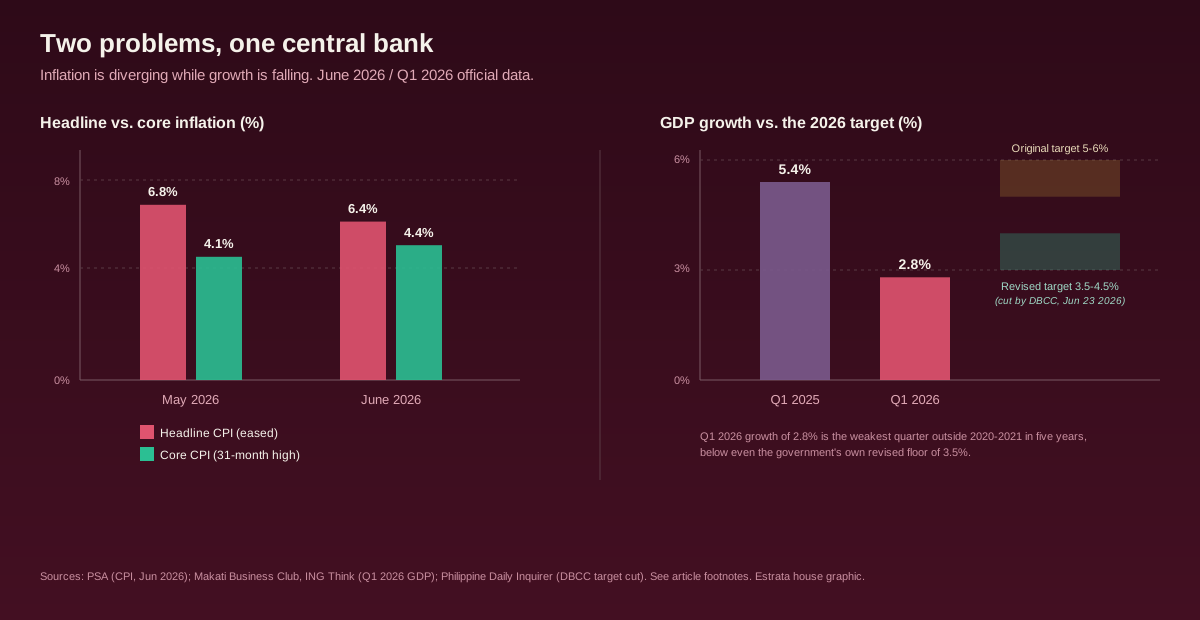
- Headline inflation eased, core did not. June 2026 headline CPI fell to 6.4 percent from May's 6.8 percent, a three-month low, but core inflation, which strips out volatile food and fuel, accelerated to 4.4 percent from 4.1 percent, its fastest pace since December 2023, a 31-month high.12
- Growth is the weakest outside a pandemic year in five years. Q1 2026 GDP grew just 2.8 percent, down from 5.4 percent a year earlier, as private consumption slowed to its softest pace since the COVID-19 period and private investment contracted outright.34
- The government has already cut its own target. The Development Budget Coordination Committee slashed the 2026 growth goal to 3.5 to 4.5 percent on June 23, from 5 to 6 percent, citing the Q1 miss.5
- The BSP is choosing inflation credibility over growth support. After a February cut to 4.25 percent, it hiked in April to 4.5 percent and again on June 18 to 4.75 percent, its second straight increase; HSBC expects another 75 basis points by year-end, to 5.50 percent.67
The headline number told half the story
Philippine inflation looked, at first glance, like it was cooling. June's headline print of 6.4 percent was the third straight monthly decline from May's 6.8 percent, driven mainly by a sharp slowdown in transport inflation, to 12.8 percent from 16.2 percent, as fuel price pressure eased.1
Core inflation moved the opposite way. Stripped of the volatile food and energy components that dominate the headline number, prices accelerated to 4.4 percent in June from 4.1 percent in May, above market forecasts and the fastest pace in 31 months, the highest reading since December 2023.2 That is the metric the BSP actually targets when it sets policy, because it captures whether price pressure has become embedded in wages and services rather than passing through from a single commodity shock. Higher Meralco electricity rates and rising wholesale power prices contributed to the June print, alongside vegetable price increases.8
The distinction matters for anyone modeling the rate path. A headline-driven inflation spike (an oil shock, a typhoon hitting vegetable supply) is the kind of thing central banks can look through once the shock passes. A core-inflation acceleration, especially one accompanying a fresh Metro Manila minimum wage increase of 85 pesos a day, about 12 percent for non-agricultural workers, is a signal that expectations are shifting and that regional wage boards elsewhere may follow suit.7 HSBC's Aris Dacanay flagged exactly this spillover risk as the reason he expects the BSP to keep hiking through the rest of 2026 even with headline inflation coming in below expectations for two straight months.7
A five-year growth low, and the graft scandal's fingerprints are on it
The growth side of the ledger is worse than the inflation side. First-quarter 2026 GDP expanded just 2.8 percent year on year, against 5.4 percent growth in the same quarter of 2025 and well below the government's original 5 to 6 percent target for the year, the weakest quarterly print outside the 2020 to 2021 pandemic downturns.4 Private consumption grew only 3 percent, the softest reading since the COVID-19 period, while private investment contracted outright as elevated joblessness and inflation pushed households toward precautionary saving rather than spending.3
On the supply side, services carried the economy at 4.5 percent growth, while industry slipped 0.1 percent and agriculture, forestry, and fishing contracted 0.2 percent.4 Public administration and defense spending was the single fastest-growing segment, up 8.6 percent, which points to where government outlays actually flowed even as overall public construction lagged.
The Department of Economy, Planning, and Development's own read on the miss ties it directly to two governance failures Estrata has tracked separately: delayed passage and release of the 2026 national budget, and the lingering effects of the flood-control procurement scandal on both public construction rollout and business confidence.4 That scandal, which began drawing corruption investigations in mid-2025, is not just a reputational problem for the Department of Public Works and Highways anymore, it is now visibly subtracting from quarterly GDP through delayed public construction spending, the same channel this publication flagged as a risk when the scandal first broke.
Our read
The BSP is running a classic emerging-market playbook under duress: hike into weak growth to defend inflation expectations and the peso, because the alternative, tolerating above-target core inflation while the currency absorbs the credibility hit, historically costs more. Three consecutive policy moves, a February cut followed by back-to-back April and June hikes, have already repriced the entire peso curve twice in five months. HSBC's forecast of another 75 basis points to a 5.50 percent terminal rate by year-end implies financing conditions stay tighter for longer than the April hike alone suggested.67
For Estrata's coverage universe, three channels matter most:
- Infrastructure and project finance. Every unfinanced PPP or renewable energy power supply agreement models a swap curve that has now moved twice this year. A terminal rate near 5.5 percent, versus the 3.75 percent some models assumed in January, compresses equity IRRs on projects still seeking financial close and raises refinancing risk for construction-stage debt.
- Public construction pipeline. The GDP data shows the flood-control scandal's fiscal drag is not abstract anymore, it is a measurable subtraction from public construction spending. Projects dependent on timely DPWH disbursement, not just flood control but the broader Build Better More pipeline, carry execution risk beyond permitting and financing.
- Consumer-facing sectors. Private consumption growth at its weakest since the pandemic, against a backdrop of elevated core inflation and a rising cost of borrowing, squeezes the remittance-fed consumption engine that has historically cushioned the Philippine economy during external shocks.
The core-inflation acceleration is the more important number of the two. A headline number driven by transport and food can fall as fast as it rose. A core number driven by wage pass-through and administered price increases is stickier, and it is the one the BSP has said it is watching.
What to watch
- The next CPI print. July 2026 inflation data, due in early August, will show whether June's core acceleration was a one-month wage-adjustment effect or the start of a trend.
- The BSP's next Monetary Board meeting. A third consecutive hike would confirm the market is right to price a 5.5 percent terminal rate; a pause would suggest the June move was intended as a decisive, front-loaded signal rather than the start of a longer cycle.
- Regional wage board decisions. If wage boards outside Metro Manila approve similarly large increases, the BSP's core-inflation concern gets stronger, not weaker.
- 2026 national budget execution data. Whether DPWH and other agencies can accelerate disbursement in the second half will determine if the flood-control scandal's growth drag is temporary or structural.
Risks to this view
A de-escalation in food and energy prices could pull core inflation down mechanically even without a change in underlying demand, since second-round effects from the earlier oil and fertilizer shock work through the CPI basket with a lag. Conversely, if regional wage boards approve large adjustments broadly, or if budget execution stays impaired into the second half, the BSP could be forced into a longer hiking cycle than HSBC's base case, with correspondingly worse consequences for growth and for asset prices that are already priced off a 2026 recovery narrative.
Estrata provides research and analysis for informational purposes only. It is not financial, investment, legal, or tax advice and is not a recommendation to buy or sell any security or asset. Figures are drawn from public sources and may contain errors; verify independently before making decisions.
Footnotes
-
Philippine Statistics Authority, "Summary Inflation Report Consumer Price Index (2018=100): June 2026": headline inflation eased to 6.4% in June 2026 from 6.8% in May, a three-month low; transport inflation slowed to 12.8% from 16.2%. https://psa.gov.ph/content/summary-inflation-report-consumer-price-index-2018100-june-2026 ↩ ↩2
-
BusinessWorld, "Philippines core inflation hits 31-month high as headline CPI eases in June" (July 8, 2026): core inflation accelerated to 4.4% in June from 4.1% in May, above market forecasts and the fastest pace since December 2023 (31 months). https://bworldonline.com/top-stories/2026/07/08/761818/philippines-core-inflation-hits-31-month-high-as-headline-cpi-eases-in-june/ ↩ ↩2
-
ING Think, "First-quarter GDP miss in the Philippines signals weaker 2026 outlook": Q1 2026 GDP grew 2.8% against a 3.3% forecast; private consumption growth slowed to 3% year on year, the weakest since the COVID-19 period; private investment contracted; BSP prioritizing inflation control over growth support. https://think.ing.com/articles/1q-gdp-miss-in-the-philippines-signals-weaker-2026-outlook/ ↩ ↩2
-
Makati Business Club, "Eco At a Glance: PH Economy GDP at Q1 2026": Q1 2026 GDP growth of 2.8% versus 5.4% a year earlier; services grew 4.5%, industry contracted 0.1%, agriculture contracted 0.2%; DEPDev Secretary Arsenio Balisacan cited delayed 2026 budget release and lingering flood-control controversy effects on public construction and confidence. https://mbc.com.ph/2026/05/07/eco-at-a-glance-ph-economy-gdp-at-q1-2026/ ↩ ↩2 ↩3 ↩4
-
Philippine Daily Inquirer, "DBCC cuts PH 2026 growth target to 3.5-4.5%" (June 23, 2026): the Development Budget Coordination Committee lowered the 2026 growth target to 3.5-4.5% from 5-6%, citing the Q1 slowdown. https://business.inquirer.net/596658/dbcc-cuts-ph-2026-growth-target-to-3-5-4-5 ↩
-
Philippine News Agency, "BSP hikes policy rates by another 25 basis points": the Monetary Board raised the target reverse repurchase rate 25 bps to 4.75% on June 18, 2026, its second straight hike, with Governor Eli Remolona Jr. citing broadening price pressures. https://www.pna.gov.ph/articles/1277571 ↩ ↩2
-
The Philippine Star, "More BSP rate hikes possible" (June 20, 2026): HSBC senior ASEAN economist Aris Dacanay expects another 75 bps of BSP hikes by year-end 2026, to a 5.50% policy rate, citing wage-driven core inflation risk following an 85-peso, roughly 12%, increase in the Metro Manila minimum wage. https://www.philstar.com/business/2026/06/20/2536399/more-bsp-rate-hikes-possible ↩ ↩2 ↩3 ↩4
-
GMA News Online, on BSP's pre-release June 2026 inflation forecast: cited higher Meralco electricity rates (up PHP 0.1488 per kWh in June), rising wholesale power prices, and vegetable prices as drivers of elevated inflation; BSP full-year 2026 forecast averaging 6.4%, decelerating to 4.5% in 2027 and 3.1% in 2028. https://www.gmanetwork.com/news/money/economy/993222/june-2026-inflation-bsp/story/ ↩