Pumped Storage's Second Act: What First Gen's Aya Deal Says About Luzon's Evening-Peak Problem
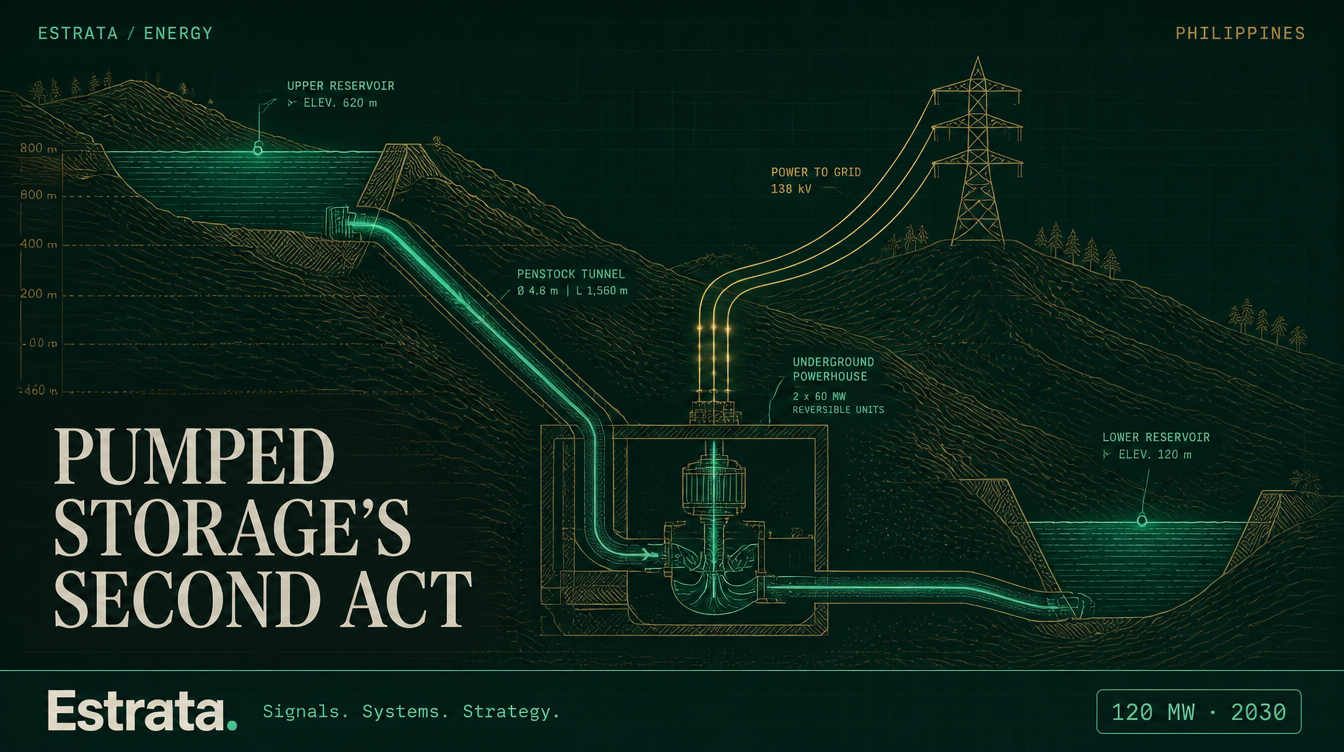
First Gen signed a 25-year agreement to build the 120-MW Aya Pumped-Storage Project in Nueva Ecija, seven years after the concept was first floated. The deal is smaller news on its own than as confirmation that pumped hydro, an asset class the Philippines has relied on a single 1980s plant for, is finally being repriced and rebuilt.
Key takeaways
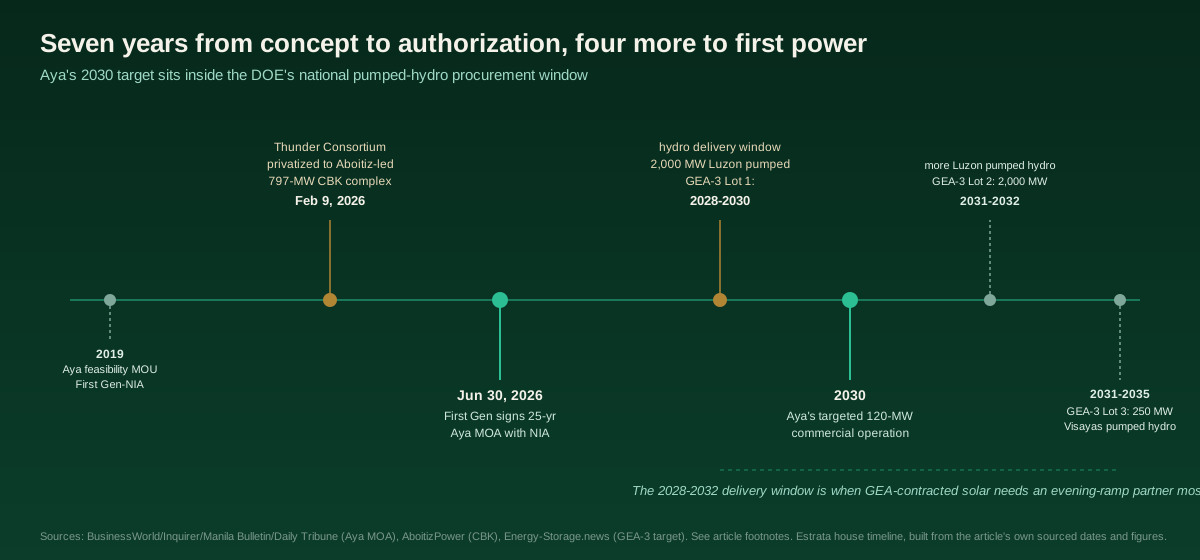
- A stalled project finally has a legal foundation. First Gen Hydro Power Corp. signed a 25-year memorandum of agreement (MOA) with the National Irrigation Administration (NIA) on June 30, 2026, authorizing it to develop, build, operate, and maintain the 120-MW Aya Pumped-Storage Project in Pantabangan, Nueva Ecija, using the existing Aya and Masiway reservoirs. The concept dates to an initial 2019 feasibility agreement with NIA.1
- It is not an isolated deal. The Philippines' only operating pumped-storage plant, the roughly 797-MW Kalayaan complex within the Caliraya-Botocan-Kalayaan (CBK) hydro system, commissioned in 1983, changed hands in February 2026 to an Aboitiz-led Thunder Consortium that has publicly committed to using it to integrate more renewable energy without sacrificing reliability.2
- The pipeline behind Aya is much bigger. The Department of Energy (DOE) raised its Green Energy Auction 3 (GEA-3) pumped-hydro procurement target to 4,250 MW in three lots: 2,000 MW for Luzon by 2028-2030, 2,000 MW for Luzon by 2031-2032, and 250 MW for Visayas through 2035.3 Aya's 2030 target lands inside that first delivery window.
- The capex figure is unconfirmed at signing. A widely cited PHP 6-billion cost estimate predates the MOA and was not restated by First Gen or NIA in their July 2026 disclosures; none of the coverage of the signing itself disclosed a capital expenditure figure.45
A decade in permitting limbo, unlocked
Pumped-storage hydropower works by moving water between an upper and lower reservoir: pumping uphill to store energy when demand is low, releasing it downhill through turbines to generate power when demand spikes. It is one of the few grid-scale storage technologies that can hold energy for hours rather than minutes, which makes it the natural complement to a grid adding gigawatts of intermittent solar.
The Aya project has been conceptually ready since 2019, when First Gen and NIA signed an initial feasibility memorandum. What changed on June 30, 2026 is that First Gen now holds a formal 25-year development authorization, renewable for another 25 years, that lets it pursue the remaining permits with NIA's official endorsement rather than exploratory access.1 NIA Administrator Eduardo Guillen framed the signing as reaffirming "shared commitment to advancing sustainable development and strengthening energy security," while First Gen senior vice president Dennis Michael Gonzales tied the project directly to grid operations: "more facilities with storage and highly flexible operating parameters are key to stabilizing the electricity grid."4
The plant will sit alongside two hydro assets First Gen already operates in the same river system, the 132-MW Pantabangan-Masiway and 165-MW Casecnan plants, giving the company an existing operations base in Nueva Ecija rather than a greenfield site.5 Commercial operations are targeted for 2030, four years out from the signing.
Our read: a four-year gap between authorization and commercial operation is normal for pumped storage, not a red flag. Reservoir-based storage requires underground powerhouse construction and multi-year civil works that batteries do not. The 2030 target should be read less as a near-term catalyst and more as a data point confirming that developers now believe the 2028-2032 window is when Luzon's storage shortage becomes acute enough to underwrite these projects.
Why the asset class just got repriced
Aya's real significance is context, not scale. Until February 2026, the Philippines had exactly one pumped-storage asset in commercial operation: the Kalayaan complex, part of the CBK hydro system built in the early 1980s and, for four decades, the only facility in the country capable of storing and dispatching power at gigawatt-hour scale. That asset just changed hands. An Aboitiz-led consortium including Sumitomo Corporation and Japan's Electric Power Development Co. (J-POWER) won the government's competitive auction for CBK and completed the formal turnover on February 9, 2026, with Aboitiz publicly stating the complex would help the grid "integrate more renewable energy... without compromising reliability."2
Two things happening in the same year, a 43-year-old pumped-storage plant being bought by a strategic consortium and a stalled 2019-vintage pumped-storage project finally getting authorized, are not a coincidence. Both are downstream of the DOE's decision to formally procure new pumped-hydro capacity through GEA-3, which lifted the national target from 4,000 MW to 4,250 MW and structured it into delivery lots running from 2028 through 2035, with a hard technical requirement for variable-speed pump-turbine technology to maximize grid flexibility.3 That auction design gave the asset class a bankable revenue path for the first time; Aya and the CBK sale are two of the earliest visible responses.
Our read: the investable story is not "First Gen builds a dam." It is that pumped hydro, previously a single legacy asset with no real market, now has a government-procured pipeline, a newly capitalized incumbent (Aboitiz-Sumitomo-J-POWER at CBK), and a re-activated challenger project (First Gen at Aya). Whoever secures the remaining GEA-3 lots, and whichever sites can reuse existing reservoirs the way Aya does, will set the cost curve for everyone who comes after.
The reliability math
The urgency behind this buildout is visible in the grid data, not just the auction paperwork. NGCP placed the Luzon and Visayas grids under red alert status in May 2026 as demand rose and multiple coal and gas units tripped offline simultaneously, exposing how concentrated Luzon's generation mix is in a small number of large thermal units.6 Independent analysis of the second-quarter 2026 outlook from the Institute for Climate and Sustainable Cities (ICSC) called the supply picture "manageable but fragile," citing plant outages, delayed committed projects, and rising cooling demand as the structural drivers, and explicitly recommended more investment in fast-ramping flexible resources including pumped hydro and batteries to reduce the risk.6
That is the demand signal pumped storage is being built against: a system that already runs uncomfortably close to its reserve margin during ordinary dry-season peaks, with 2030-2032 the window when several gigawatts of solar contracted under earlier GEA rounds are expected to be fully online and needing an evening-ramp partner.
What to watch
Three things determine whether Aya (and the broader pumped-hydro pipeline behind it) delivers on schedule rather than sliding, as it already has once. First, financial close: no capex figure has been publicly reconfirmed since the MOA, and pumped-storage projects of this scale typically require project financing secured well before construction start. Second, the remaining permitting stack, environmental clearance and any additional NIA sub-agreements beyond the development MOA. Third, whether First Gen and the DOE's other GEA-3 winners hit the 2028-2030 first-lot delivery window; a slip there would tighten the 2030-2032 reliability window this analysis flags as the real reason the project matters now. None of these are visible yet in public disclosures, and this analysis will revisit the project once financial close or a construction start is confirmed.
Footnotes
-
BusinessWorld/Inquirer coverage of the First Gen-NIA MOA: signed June 30, 2026; 25-year term renewable for 25 more years; 120-MW capacity; Pantabangan, Nueva Ecija; targeted 2030 commercial operations; project traces to a 2019 feasibility MOU. https://business.inquirer.net/599096/first-gen-nia-advance-with-120-mw-hydro-project ↩ ↩2
-
AboitizPower, "AboitizPower-led Thunder Consortium acquires 797-MW CBK hydro, pumped storage complex": February 9, 2026 formal turnover; consortium members Aboitiz Renewables, Sumitomo Corporation, and Electric Power Development Co. (J-POWER); quotes on renewable integration and grid resilience. https://aboitizpower.com/news/hydro/aboitizpower-led-thunder-consortium-acquires-797-mw-cbk-hydro-pumped-storage-complex ↩ ↩2
-
Energy-Storage.news, "Philippines ups pumped hydro procurement target to 4,250 MW": DOE Green Energy Auction 3 (GEA-3) target raised from 4,000 MW to 4,250 MW, structured in three lots (2,000 MW Luzon 2028-2030; 2,000 MW Luzon 2031-2032; 250 MW Visayas through 2035); variable-speed pump-turbine technical requirement. https://www.ess-news.com/2025/01/13/philippines-ups-pumped-hydro-procurement-target-to-4250-mw/ ↩ ↩2
-
Manila Bulletin, "First Gen to develop 120-MW Nueva Ecija pumped-storage facility": underground powerhouse configuration, Aya and Masiway reservoirs, quotes from NIA Administrator Eduardo Guillen and First Gen SVP Dennis Michael Gonzales. https://mb.com.ph/2026/07/06/first-gen-to-develop-120-mw-nueva-ecija-pumped-storage-facility ↩ ↩2
-
Daily Tribune, "NIA approves First Gen's 120-MW Aya pumped-storage project in Nueva Ecija": confirms the 132-MW Pantabangan-Masiway and 165-MW Casecnan plants as First Gen's existing adjacent assets, and the evening-peak rationale for storage. https://tribune.net.ph/2026/07/07/nia-approves-first-gens-120-mw-aya-pumped-storage-project-in-nueva-ecija ↩ ↩2
-
GMA News, "PH power outlook for April to June 2026 manageable but fragile": May 2026 red alert status for Luzon and Visayas grids; ICSC analysis citing plant outages, delayed projects, and rising cooling demand; recommendation for more flexible storage investment. https://www.gmanetwork.com/news/money/economy/981195/ph-power-outlook-april-june-2026/story/ ↩ ↩2